TL;DR
H2 lab reports measure dissolved hydrogen concentration (in ppm or mg/L), test for water safety, and document the conditions under which testing occurred. The gold standard method is gas chromatography, and the minimum therapeutic threshold set by the IHSA is 0.5 ppm. When interpreting H2 lab reports for hydrogen water bottles, always check whether the report uses GC testing, documents test conditions, shows averages rather than cherry-picked peaks, and includes a water purity panel alongside concentration data.
Every serious hydrogen water bottle brand posts lab reports. Few buyers know how to read them.
You have probably landed here because you downloaded a PDF from a product page, opened it, and found yourself staring at abbreviations like PQL, TCD, SATP, and GC without any clear explanation of what they mean or whether the numbers are actually good. You are not alone. Practitioners on Reddit’s biohacker and chemistry communities consistently point out that lab reports are shared as trust signals, but almost nobody teaches consumers how to evaluate them.
This guide changes that. After reading it, you will know what every line item means, which metrics actually matter, what is filler, and how to compare two brands’ reports head to head. Whether you are considering your first hydrogen water bottle or vetting a specific brand’s claims, this is the decoder ring the industry has been missing.
For a broader introduction to molecular hydrogen science, explore the clinical research behind molecular hydrogen before diving in.
Measurement and Concentration Terms
These are the numbers that matter most. Every H2 lab report leads with concentration data, and understanding what the figures mean (and what they should look like) is the first step toward interpreting H2 lab reports for hydrogen water bottles with confidence.
PPM (Parts Per Million)
PPM measures how many milligrams of dissolved hydrogen exist in one liter of water. It is the standard unit you will see on virtually every lab report and product spec sheet. A reading of 1.0 ppm means there is 1 milligram of molecular hydrogen dissolved in every liter of water tested.
Why it matters: PPM is the primary number that determines whether a hydrogen water bottle produces a therapeutic dose. The IHSA sets the minimum therapeutic standard at 0.5 ppm (500 ppb). Anything below that threshold has not been shown to deliver meaningful benefits in clinical research.
What to look for: Check whether the reported ppm is a single reading or an average of multiple tests. Averages are more reliable. Also confirm which cycle time produced the number, because a 10-minute cycle will almost always yield higher ppm than a 3-minute cycle.
PPB (Parts Per Billion)
PPB is simply a finer unit of measurement. One ppm equals 1,000 ppb. So when a brand advertises “4,000 PPB,” that is 4.0 ppm. Some companies prefer PPB because the larger number looks more impressive in marketing materials.
What to look for: Do the math. Divide by 1,000 to convert to ppm. If a report lists results only in PPB and the number seems massive, check whether it actually crosses the 500 ppb (0.5 ppm) minimum once you account for realistic conditions.
mg/L (Milligrams Per Liter)
For practical purposes, mg/L and ppm are interchangeable when discussing dissolved hydrogen in water. Lab reports tend to use mg/L because it is the formal scientific notation. If a report says 1.5 mg/L, that equals 1.5 ppm.
Saturation Point
At room temperature (25°C) and normal atmospheric pressure (1 atm), water maxes out at approximately 1.57 to 1.6 mg/L of dissolved hydrogen. This is a hard physical limit governed by Henry’s Law, which describes how gas solubility is proportional to the pressure above the liquid.
Why it matters: Any claim above 1.6 ppm at standard conditions requires an explanation, usually involving pressurization or supersaturation. Claims of 3, 4, or 5 ppm are not physically impossible, but they require a sealed system that builds internal pressure beyond one atmosphere during electrolysis.
Supersaturation
When a hydrogen water bottle generates H2 inside a sealed vessel, internal pressure rises above 1 atmosphere, forcing more gas into solution than would dissolve under open-air conditions. Think of a sealed can of sparkling water: the CO2 stays dissolved because the can is pressurized. Open it, and the gas starts escaping. The same principle applies to dissolved hydrogen.
What to look for: If a brand claims supersaturation levels (above 1.6 ppm), the report should explain the sealed testing protocol and note whether the reading was taken while still sealed or after opening. The distinction matters enormously for real-world use.
Dissolved Hydrogen Concentration
This is the core measurement in any H2 lab report. It tells you how much molecular hydrogen is actually in the water, which is the only form your body can absorb. Surface bubbles, visible fizz, or a negative ORP reading do not confirm dissolved hydrogen levels on their own.
Daily Dose (mg H₂)
The formula is simple: H₂ concentration (ppm) × volume of water (liters) = milligrams of H₂ ingested. The IHSA’s guideline sets a practical target of at least 0.5 mg per day based on consuming up to 1 liter.
For example, if your bottle produces 2.5 ppm and you drink 300 mL (0.3 L), your dose is 0.75 mg of H₂, which exceeds the minimum threshold. But if the same bottle only hits 0.8 ppm and you drink 150 mL, your dose drops to 0.12 mg, well below the therapeutic range.
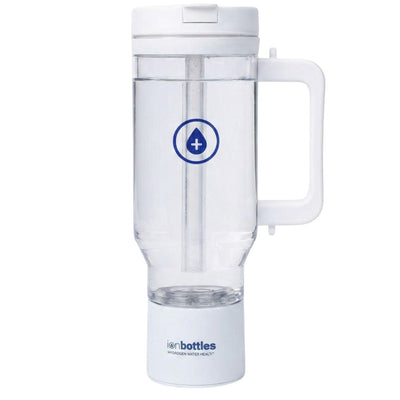
Volume matters as much as concentration. The 32 oz Tumbler offers a straightforward way to maximize daily hydrogen intake for those who want both high capacity and strong concentration in a single session.
Testing Methods and Instruments
How the hydrogen was measured is just as important as the number itself. A lab report that does not specify its testing method should raise immediate questions.
Gas Chromatography (GC)
Gas chromatography is the gold standard for measuring dissolved hydrogen in water and the only method currently authorized by the IHSA. The process works by injecting a water sample into the instrument, heating it to volatilize (remove) the dissolved hydrogen from the liquid, then pushing the gas through a column using an inert carrier gas like argon or nitrogen. A detector at the other end measures the hydrogen content and compares it against a calibration standard.
Why it matters: According to the Molecular Hydrogen Institute, many claimed methods for measuring hydrogen are inaccurate, including pH meters, ORP meters, and air-based H2 sensors that cannot be used for water. Having independent GC results confirming concentration is significant because it eliminates the possibility of false readings.
Headspace Analysis
This is the specific GC sampling technique used for dissolved H2. The test sample is injected, heat volatilizes the dissolved gas into the headspace above the liquid inside the instrument, and that gas is then swept into the chromatographic column. You will see “headspace GC” or “HS-GC” referenced in the methodology section of rigorous reports.
Thermal Conductivity Detector (TCD)
The TCD is the detector type most commonly used in hydrogen gas chromatography setups. After the gas passes through the column, it reaches the TCD, which measures changes in thermal conductivity caused by the presence of hydrogen. The detector’s response is proportional to the amount of dissolved hydrogen in the sample.
Chromatogram
The chromatogram is the visual output of a GC analysis: a graph with a peak whose area corresponds to hydrogen concentration. Lab software calculates the area under the curve and compares it to a stored calibration standard to produce the final ppm reading.
What to look for: A thorough lab report includes the chromatogram image or references it. If you see only a concentration number with no mention of GC methodology or chromatogram data, the testing may have used a less reliable method.
H2Blue Reagent Drops
H2Blue is the most common home testing method. Each drop that turns clear in a 6 mL water sample represents roughly 0.1 ppm (100 ppb) of dissolved hydrogen. You count the drops until the blue color persists, and that gives your reading.
Critical caveats:
- Stirring the sample can cause up to 70% of the hydrogen to dissipate, giving a falsely low reading.
- H2Blue reacts with other reducing agents, not just hydrogen. If your water contains vitamin C or high chlorine levels, the result will be falsely high.
- The “ECO” version of H2Blue is not suitable for accurate testing, as it often produces false zero readings due to its non-alcohol formula.
- H2HUBB, which uses H2Blue for confirmation tests, strives to align results within a 5 to 20% range of GC measurements, acknowledging the inherent gap between titration and chromatography.
ORP (Oxidation-Reduction Potential)
ORP measures the overall electrical potential of water in millivolts. A strongly negative ORP reading (say, -500 mV) indicates the water has reducing properties. Some brands showcase ORP numbers as proof of hydrogen content, but this is misleading.
Why ORP is not a hydrogen measurement: The IHSA explicitly discourages methods that depend on ORP to estimate hydrogen concentration. ORP does not measure hydrogen directly. It reads overall electrical activity, which is influenced by pH, mineral content, dissolved oxygen, and other factors. You can get a strongly negative ORP reading with negligible actual H2 present.
Practitioners in science-focused Reddit communities consistently urge testing with H2 titration rather than ORP when evaluating devices. It is one of the few points where the skeptic and biohacker communities fully agree.
What to look for: If a company only shows ORP numbers without GC or titration data, treat the ppm claims with skepticism. ORP can be a supporting data point, but it should never be the primary evidence.
To understand how SPE/PEM electrolysis technology produces hydrogen without ozone or chlorine byproducts, learn how SPE/PEM electrolysis works.
Lab Report Components
Beyond the concentration number itself, a well-constructed lab report documents exactly how and under what conditions the testing occurred. These details determine whether the results are reproducible and comparable.
Test Conditions
This section specifies the controlled variables: water type, temperature, altitude/atmospheric pressure, sample volume, and sometimes the container used. For example, a thorough report might document: ultrapure water (ASTM Type I), temperature of 25°C ± 1.5°, conductivity of 0 μS/cm, pH of 6.4, and laboratory elevation adjusted to standard atmospheric pressure.
Why it matters: Every one of these variables affects dissolved hydrogen readings. A report without test conditions is essentially a number without context. You have no way of knowing whether the results are reproducible or how they translate to your kitchen.
SATP (Standard Ambient Temperature and Pressure)
SATP is the normalization standard used to make results comparable across different labs: 25°C and 1 atm (101.325 kPa). When a report says results are “adjusted to SATP,” it means the raw data has been corrected for the lab’s actual temperature and altitude so that it can be compared apples-to-apples with reports from other facilities.
Mean and Standard Deviation (SD)
Reports from credible labs run multiple tests, not just one. The mean is the average of those tests. The standard deviation tells you how consistent the results were across repetitions.
For example, the Echo Go’s lab report conducted three tests for each cycle time, recorded the results, and calculated the mean and standard deviations. A low SD relative to the mean indicates consistent performance. A high SD suggests the device produces variable results, which is a concern.
What to look for: If a report shows only a single reading with no SD, the results are less trustworthy than averaged data from multiple trials.
Practical Quantification Limit (PQL)
The PQL is the lowest concentration that a particular analytical method can reliably measure and report with confidence. When you see “ND” (Non-Detect) in a results field, it means the substance was present below this threshold, not necessarily that it was completely absent.
Non-Detect (ND)
ND appears most often on water quality panels for contaminants like lead, mercury, or arsenic. It means the lab’s instruments could not detect the substance above the PQL. In plain terms: the contaminant is either not present or present at levels too low to measure, both of which are good news.
Cycle Time
Hydrogen water bottles run electrolysis for a set duration: 3, 5, 10, or 20 minutes depending on the model and setting. The lab report should specify which cycle time produced the reported concentration.
Why it matters: A report showing 5.0 ppm from a 20-minute cycle tells a very different story than 5.0 ppm from a 5-minute cycle. Always check which cycle was tested, because that determines what you will realistically experience during normal use. Refer to the ATOM user manual for specific cycle time details and usage guidance.
Peak vs. Average Concentration
This is one of the most important distinctions in interpreting H2 lab reports for hydrogen water bottles. A peak concentration is the highest single reading recorded during testing. An average is the mean across multiple tests and cycles.
H2HUBB reports explicitly state that their primary results are averages rather than peak concentrations. Averages are more honest because they reflect typical performance, not a best-case outlier.
What to look for: If a brand’s marketing prominently features a number that matches the highest peak in the lab report rather than the average, they are cherry-picking. Check the report itself for the distinction.
Safety and Purity Testing
Concentration numbers tell you how much hydrogen is in the water. They say nothing about whether the water is safe to drink. A complete lab report addresses both.
Water Quality Panel / Purity Analysis
H2 Analytics offers EPA-certified testing of the water produced by H2 devices to ensure they do not add harmful contaminants such as heavy metals, chlorine, or other byproducts. This panel tests the output water, not the input water, which is a critical distinction. It answers the question: “Did the electrolysis process introduce anything harmful?”
EPA Safe Drinking Water Act Compliance
When a report references EPA standards, it means the tested water met the safety thresholds established under U.S. federal drinking water regulations. The IHSA certification process requires technologies to demonstrate that their output water is safe for consumption per EPA guidelines.
Heavy Metals Testing
Lead, mercury, arsenic, and cadmium are the primary contaminants tested. “ND” on these lines means the lab could not detect them above the PQL, which is the result you want to see. Some lower-quality devices with poor electrode materials can leach metals into the water during electrolysis.
Ozone and Chlorine Byproducts
Cheap single-chamber electrolysis designs can produce ozone and chlorine gas as byproducts, which then dissolve into the water you drink. Dual-chamber designs using SPE (Solid Polymer Electrolyte) and PEM (Proton Exchange Membrane) technology separate these gases from the hydrogen output, venting them away from the drinking water.
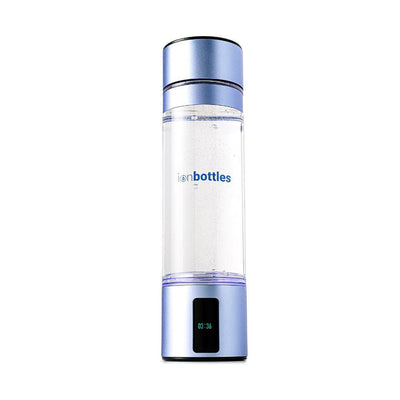
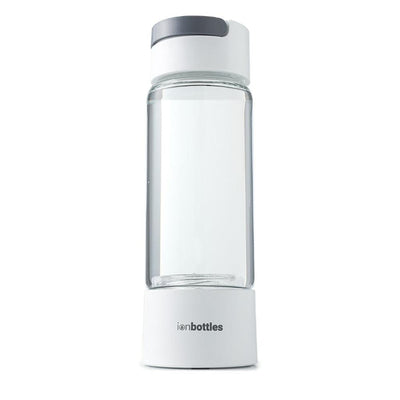
What to look for: A lab report from a well-designed bottle should show ND for ozone and chlorine byproducts. If the report does not test for these substances at all, that is a gap worth questioning. The IonBottles Pro glass hydrogen water bottle uses SPE/PEM electrolysis specifically designed to prevent these byproducts from reaching the water you drink.
Certifications and Trust Signals
Certifications exist to prevent brands from making claims that their devices cannot support. Knowing who certifies, what they check, and how to verify claims is essential when interpreting H2 lab reports for hydrogen water bottles.
IHSA (International Hydrogen Standards Association)
The IHSA was established in September 2016 with a clear mission: define what “hydrogen water” actually means, define how to accurately measure it, ensure safety standards are met, and authorize testing facilities. They set the minimum therapeutic threshold at 0.5 ppm and require GC as the testing method.
IHSA Certification
IHSA certification confirms two things: the device produces hydrogen at or above the therapeutic threshold (0.5 ppm), and the output water meets EPA safety standards. The IHSA has noted that some companies claim certification they do not actually hold, encouraging consumers to verify directly with the certifying entity.
A concerning reality: A large percentage of hydrogen water technologies on the market today cannot achieve IHSA certification because they fail to reach the minimum 0.5 ppm threshold. This is why independent lab verification matters so much.
H2 Analytics
Based in Henderson, Nevada, H2 Analytics is the primary IHSA-approved testing facility. They perform both GC-based hydrogen concentration testing and EPA-certified water quality analysis. If a lab report comes from H2 Analytics, it carries significant weight in the hydrogen water community.
H2HUBB
H2HUBB acts as an independent evaluator that performs confirmation testing on products that have already been tested by H2 Analytics. They use H2Blue reagent drops for their confirmation process and aim to align within 5 to 20% of the GC measurements. Products that have undergone H2 Analytics testing first can be expedited through the H2HUBB evaluation process.
ISO/IEC 17025
This is the international standard for testing and calibration laboratories. When a lab holds ISO/IEC 17025 accreditation, it means the facility itself meets rigorous quality management requirements, including documented procedures, equipment calibration, staff competence, and result traceability. A report from an ISO/IEC 17025 lab carries more weight than one from an unaccredited facility.
FDA GRAS Status
The FDA recognizes hydrogen gas as GRAS (Generally Recognized As Safe). This is not an endorsement of therapeutic benefits, but it confirms that molecular hydrogen itself is considered safe for consumption.
Lab PPM vs. Your Kitchen PPM: Why the Numbers Will Not Match
This is arguably the most important section for anyone comparing their home H2Blue test results to a brand’s lab report. In professional laboratories, variables are tightly controlled using gas-tight syringes, sealed containers, calibrated instruments, ultrapure water, and precise temperature management. That is why lab results are always higher and more consistent than what you will get at home.
Here are the specific variables that create the gap:
Temperature. Colder water retains more dissolved gas. Labs test at a controlled 25°C. If your tap water is warmer, your readings will be lower. If it is colder, they might be slightly higher initially, but hydrogen still escapes faster once the bottle is opened.
Altitude. Dissolved H2 drops by roughly 10% per 1,000 meters of elevation. A lab in Henderson, Nevada (864 m elevation) already adjusts results to SATP. If you live in Denver (1,600 m), expect measurably lower readings than the published report.
Sealed vs. open sampling. Testing water while the bottle is still sealed gives a higher reading than testing after pouring into a cup. Hydrogen begins escaping the moment water contacts open air. Its half-life in an open container is approximately 2 hours at room temperature in 500 mL, and the initial loss in the first 30 seconds is significant.
Cycle stacking. Running multiple electrolysis cycles back to back temporarily inflates readings above what a single-cycle user experiences. Check whether the lab report specifies single-cycle or stacked-cycle results.
Water type. Purified, low-TDS water tends to hold hydrogen better than mineral-rich water. Labs often use ultrapure water (ASTM Type I), which is nothing like your filtered tap water. Water composition plays a massive role in real-world concentration.
Electrode condition. Users on Reddit’s r/Skeptic report ppm output declining over months when they run many daily cycles without descaling. Neglecting maintenance is one of the top reasons hydrogen water bottles lose output over time.
Understanding this gap is not a reason to dismiss lab reports. It is a reason to read them carefully and set realistic expectations.
How to Compare Two Lab Reports: A Practical Checklist
When you are evaluating any brand’s report, or comparing two brands side by side, run through these six questions:
-
Does the report specify gas chromatography as the testing method? If no GC is mentioned, the concentration data may be unreliable. Methods that depend on ORP or uncalibrated sensors may falsely indicate therapeutic levels when the water contains only trace amounts of hydrogen.
-
Are full test conditions documented? You need water type, temperature, atmospheric pressure or altitude, and sample size. Without these, the numbers lack context.
-
Are results reported as averages or peaks? Averages from multiple trials with standard deviations reported are far more trustworthy than a single peak reading.
-
Is there a water quality/safety panel? Hydrogen concentration alone does not prove safety. Look for EPA-compliant heavy metals and contaminant testing on the output water.
-
Which cycle time produced the reported numbers? A 10-minute cycle and a 3-minute cycle will produce very different results. The report should make this clear, and the marketed ppm should match the cycle most users will actually run.
-
Can the certification be independently verified? If a brand claims IHSA certification, H2HUBB validation, or ISO/IEC 17025 lab accreditation, those claims should be verifiable through the certifying organization. The IHSA has explicitly warned about companies claiming certifications they do not hold.
Quick Reference: Green Flags vs. Red Flags
| Green Flags | Red Flags |
|---|---|
| GC testing specified and chromatogram included | No testing method mentioned |
| Multiple trials with mean and SD reported | Single reading, no SD |
| Full test conditions documented | No temperature, water type, or altitude noted |
| Water safety panel with EPA compliance | Only concentration data, no purity testing |
| Average concentrations prominently displayed | Only peak or “up to” numbers shown |
| IHSA certification verifiable with certifying body | Certification claimed but not verifiable |
| Testing lab identified by name and accreditation | Anonymous or unspecified lab |
| Ozone/chlorine byproduct testing included | No mention of byproduct testing |
IonBottles publishes its ATOM lab results from the Swiss Water Research Institute, an ISO/IEC 17025 accredited facility, reporting 2.5 ppm at 5 minutes and 5.0 ppm at 10 minutes along with a water purity panel. To see how these numbers break down in practice, view the ATOM hydrogen water bottle’s full specs and lab-verified performance.
A Decision Tree for Evaluating Any H2 Lab Report
Use this sequence when you are handed any lab report PDF:
Step 1: Does it use gas chromatography?
→ Yes: proceed. → No: treat all ppm claims with skepticism.
Step 2: Does it document test conditions (water type, temp, altitude)?
→ Yes: proceed. → No: the results cannot be compared to other reports or to your real-world use.
Step 3: Are the results averages with standard deviations?
→ Yes: proceed. → No: ask whether the reported number is a peak or single trial.
Step 4: Is there a water safety panel?
→ Yes: proceed. → No: concentration without safety data is incomplete.
Step 5: Does the device meet the 0.5 ppm IHSA minimum?
→ Yes: it crosses the therapeutic threshold identified in published research. → No: the 3,000+ peer-reviewed H2 publications and 200+ clinical studies that suggest therapeutic potential used concentrations at or above this level.
Step 6: Is any claimed certification verifiable?
→ Yes: you have a report worth trusting. → No: proceed with caution.
Frequently Asked Questions
What is the minimum ppm for hydrogen water to be effective?
The IHSA sets the minimum therapeutic threshold at 0.5 ppm (500 ppb), based on concentrations used in clinical studies. Products below this level have not been demonstrated to deliver meaningful benefits. The daily dose also depends on how much water you drink: 0.5 ppm × 1 liter = 0.5 mg of H2, which meets the baseline standard.
Why does my H2Blue test give a lower reading than the lab report?
Lab reports are produced under tightly controlled conditions: ultrapure water, precise temperature, sealed sampling, calibrated instruments, and standardized atmospheric pressure. At home, your water type, temperature, altitude, open-air exposure, and even how gently you handle the sample all reduce the reading. A gap between lab and home results is normal and expected.
Is a negative ORP reading proof that my water has hydrogen?
No. A negative ORP reading indicates reducing properties in the water, but it does not measure hydrogen concentration directly. pH, mineral content, dissolved oxygen, and other factors all affect ORP. The IHSA discourages relying on ORP to estimate hydrogen levels. Always look for GC or titration data instead.
What is gas chromatography and why is it the gold standard?
Gas chromatography is an analytical technique that separates and measures gases in a sample. For hydrogen water, it volatilizes the dissolved H2, pushes it through a column, and detects its concentration with high precision. It is the only method currently authorized by the IHSA for certifying hydrogen water products because it directly and accurately measures the dissolved hydrogen itself.
Can hydrogen water bottles produce more than 1.6 ppm?
Yes, through supersaturation. At room temperature and 1 atmosphere of pressure, water can hold about 1.57 to 1.6 ppm of dissolved hydrogen. But sealed electrolysis builds internal pressure above 1 atmosphere, forcing more gas into solution (Henry’s Law). Claims of 2, 3, or 5 ppm are physically plausible in a pressurized system, but the hydrogen begins escaping once you open the bottle.
What should I do if a brand claims IHSA certification?
Verify it directly with the IHSA. The organization has publicly warned that some companies claim certification they do not hold. Check the IHSA website or contact them to confirm the product is listed.
How often should I descale my hydrogen water bottle to maintain ppm output?
Maintenance frequency depends on your water hardness and how many cycles you run daily. Users in Reddit’s skeptic forums report noticeable ppm decline over months when descaling is neglected. Follow your device’s maintenance instructions to keep electrode performance consistent. For common questions on maintenance and usage, visit the IonBottles FAQ page.
Does altitude affect hydrogen water concentration?
Yes. Dissolved H2 drops by approximately 10% per 1,000 meters of elevation. If you live at high altitude, expect lower real-world ppm than what a lab report (typically adjusted to SATP at sea level) shows. This is basic gas solubility physics and applies to all hydrogen water devices, not just specific brands.
The Bottom Line
Lab reports exist to prove or disprove marketing claims. Learning to read them is the single most effective way to separate credible hydrogen water products from marketing-first brands that rely on consumer confusion.
Focus on the fundamentals: gas chromatography testing, documented test conditions, averaged results with standard deviations, a water purity panel, and verifiable certifications. Skip the ORP hype. Understand why your home test will never perfectly match a lab result. And always check which cycle time and water type produced the headline number.
Transparency is the dividing line. Brands that publish complete, verifiable lab data invite scrutiny because they can withstand it. To explore a lineup of lab-verified hydrogen water bottles built around this standard of transparency, browse all IonBottles hydrogen water bottles.