TLDR
A hydrogen bottle is only “lab-tested” in any useful sense if the exact model, measurement method, cycle length, water conditions, and dissolved H₂ result are documented and available for you to review. Before spending $80 to $300 or more, check for SPE/PEM electrolysis, a third-party lab report using gas chromatography or another direct hydrogen measurement method, clearly stated PPM or PPB results, and a real warranty with a return policy. This consumer checklist for buying lab-tested hydrogen bottles walks through every term, test, and red flag so you can separate proof from marketing.
“Lab-tested” might be the most important phrase on a hydrogen water bottle product page. It is also one of the easiest to fake.
The problem is not whether molecular hydrogen can dissolve in water. It can. The concept is straightforward: H₂ gas dissolves into liquid water, similar to how CO₂ dissolves into sparkling water, though hydrogen is far less soluble and escapes much faster. The real problem is whether a specific bottle sitting in your Amazon cart actually produces measurable dissolved hydrogen safely, consistently, and at anything close to what the listing claims.
Practitioners on Reddit report real frustration here. In one thread on r/H2O_Official, a user asked for recommendations because their bottle’s advertised 1,600 PPB was “not even close” to reality. Another commenter in the same discussion said a bottle marketed at 8,000 PPB only measured around 1,300 PPB after two full cycles source. These are not isolated complaints. They point to a category where marketing routinely outpaces performance.
This guide is a consumer checklist for buying lab-tested hydrogen bottles built around definitions, proof standards, and red flags. It will not tell you which bottle to buy. It will teach you how to tell whether any bottle’s claims deserve your trust.
Quick Checklist Before Buying a Lab-Tested Hydrogen Bottle
If you want the short version, here are 15 things to verify before you hand over your credit card. Each one is explained in depth below.
- Does the lab report name the exact bottle model you are buying?
- Is the report dated and relevant to the current product version?
- Is the testing lab identified by name?
- Does the report use gas chromatography or another direct dissolved H₂ method?
- Does it specify the cycle length tested (3, 5, 10, or 20 minutes)?
- Are water type, temperature, volume, and measurement timing listed?
- Is the dissolved hydrogen result reported in PPM, PPB, or mg/L?
- Can you calculate the total H₂ dose per serving?
- Is there any retention data showing how long hydrogen stays in the water?
- Does the bottle use SPE/PEM membrane-based electrolysis?
- Is there a waste-gas vent or dual-chamber byproduct explanation?
- Are electrode materials specified (such as platinum-coated titanium)?
- Are bottle-contact materials food-safe (glass, BPA-free Tritan, or equivalent)?
- Are cleaning and descaling instructions included?
- Is there a real warranty, return policy, and reachable support team?
A bottle that clears all fifteen points is giving you something rare in this market: transparency. One that fails on multiple points might still work, but you are taking the seller’s word for it.
What “Lab-Tested” Should Actually Mean
When a brand stamps “lab-tested” on a product page, most buyers assume an independent scientist verified the bottle works. That may or may not be true. The phrase has no legal definition in this product category, and it can mean anything from a full third-party gas chromatography analysis to an in-house drop test done once during prototyping.
A meaningful lab report should include:
- Exact product model matching what you are purchasing
- Test date that is reasonably current
- Named testing lab, ideally independent from the manufacturer
- Measurement method, preferably gas chromatography or another direct hydrogen measurement
- Water conditions: type (distilled, filtered, tap), temperature, and TDS
- Fill volume tested
- Cycle length: which mode or timing was used
- Measurement timing: was hydrogen measured immediately, or after 5, 10, 30 minutes?
- Number of replicates or repeat tests
- Result in PPM, PPB, or mg/L
- Byproduct/purity data if the brand claims “no ozone” or “no chlorine”
- Whether the report applies to the current hardware revision
If any of these are missing, you are looking at partial proof at best.
The 10-Point Lab Report Audit
Score any bottle’s lab documentation against this framework:
| Lab proof item | Points |
|---|---|
| Exact model name matches product page | 1 |
| Test date shown and reasonably current | 1 |
| Independent lab named | 1 |
| Lab accreditation stated (such as ISO/IEC 17025) | 1 |
| Direct H₂ measurement method stated | 1 |
| Water type, volume, temperature, and cycle length listed | 1 |
| Result shown in PPM, PPB, or mg/L | 1 |
| Replicates or repeat tests shown | 1 |
| Byproduct/purity panel included | 1 |
| Report is publicly available, not just a badge | 1 |
8 to 10 points: Strong proof. 5 to 7: Partial, worth asking the brand for more detail. 0 to 4: Marketing claim, not consumer-grade evidence.
What ISO/IEC 17025 Actually Means
You will see this standard referenced on some lab reports. ISO/IEC 17025 is the international standard for the competence of testing and calibration laboratories source. It means the lab has been assessed for its ability to produce accurate and reliable test results. NIST clarifies that accreditation under this standard is a finding of laboratory competence, not a guarantee of any specific test result source. In other words, it tells you the lab knows how to run tests properly. It does not tell you the product is good.
Hydrogen Bottle Glossary: Every Term Explained
This section covers the vocabulary you will encounter while shopping. Each entry follows the same structure: what it means, why it matters, how to verify it, and what should raise concern.
Molecular Hydrogen (H₂)
Plain meaning: A gas made of two hydrogen atoms bonded together. When dissolved in water, it creates what is marketed as “hydrogen water” or “hydrogen-rich water.”
Why it matters: Hydrogen water does not mean extra hydrogen atoms are added to the H₂O molecule. It means molecular hydrogen gas is dissolved in the water, separate from the water molecule itself. A sports dietitian explained this same confusion on LinkedIn: the added H₂ remains distinct from the hydrogen atoms already covalently bonded in H₂O source.
Red flag: Any product page that implies the water molecule itself is being enhanced or restructured.
PPM (Parts Per Million)
Plain meaning: A concentration measurement. In hydrogen water, 1 PPM roughly equals 1 milligram of hydrogen per liter of water.
Why it matters: This is the core number buyers compare across products. But PPM alone does not tell the whole story without knowing cycle length, water conditions, and measurement timing.
Red flag: “Up to 5 PPM” with no test conditions, method, or timing disclosed.
PPB (Parts Per Billion)
Plain meaning: A smaller unit of concentration. 1,000 PPB equals 1 PPM.
Why it matters: Some brands use PPB because the numbers look bigger. A bottle claiming 5,000 PPB and one claiming 5.0 PPM are stating the same concentration. Always convert before comparing.
Red flag: A listing that makes 3,000 PPB sound vastly superior to 3 PPM. They are the same thing.
Dose
Plain meaning: The total amount of molecular hydrogen you actually consume, usually measured in milligrams.
Why it matters: A small bottle with high PPM and a large bottle with lower PPM can deliver different total doses. The formula is simple: PPM multiplied by liters of water consumed equals milligrams of H₂.
The International Hydrogen Standards Association (IHSA) sets a minimum dose standard of 0.5 mg of H₂ ingested within a maximum of 1 liter of product water source. Devices below 0.5 mg/L cannot meet this standard because they cannot deliver that dose in a single liter.
Red flag: A brand that talks only about peak PPM and never mentions serving volume or consumption timing.
Here is why dose math matters in practice: a 300 mL bottle at 5.0 PPM delivers about 1.5 mg of H₂. A 1-liter bottle at 1.5 PPM also delivers about 1.5 mg of H₂. The concentration headline number is not the whole picture.
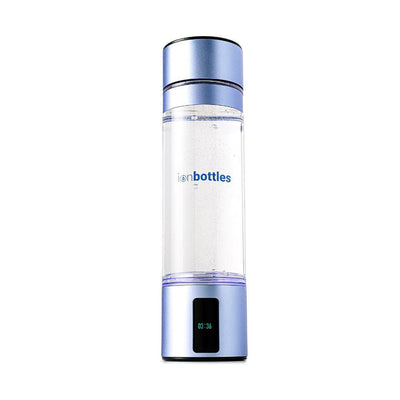
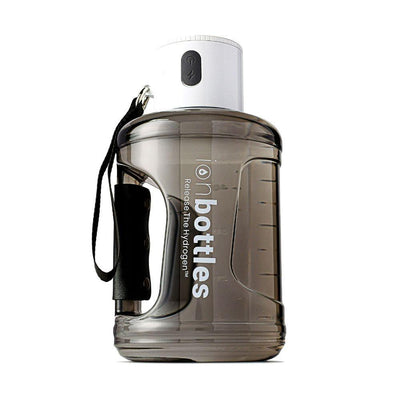
IonBottles offers a useful example of how concentration and capacity trade off across a product line. The compact ATOM hydrogen water bottle is 10 oz and advertised up to 5.0 PPM, while the 50 oz Tritan Sport Jug is advertised around 1.0 to 2.0 PPM. Different bottles, potentially comparable doses depending on how much water you drink per serving.
SPE/PEM
Plain meaning: Solid Polymer Electrolyte / Proton Exchange Membrane. A technology used in electrolysis to separate hydrogen production from oxygen and byproduct gases.
Why it matters: This is one of the most important hardware distinctions in hydrogen bottles. An SPE/PEM design uses a membrane to keep hydrogen-rich drinking water separate from the oxygen, ozone, and chlorine byproducts generated during electrolysis. Without it, those byproducts mix into the water you drink.
A LinkedIn post from a hydrogen technology practitioner offers a practical physical check: look for a small vent or oxygen release port on the device, because proper SPE/PEM designs need a way to exhaust unwanted gases source.
How to verify: Check the product page, manual, and any exploded-view diagrams. Look for mention of dual-chamber design and a physical exhaust path. You can learn more about how SPE/PEM electrolysis technology works in detailed breakdowns.
Red flag: Generic “electrolysis” with no mention of a membrane or byproduct separation.
Dual-Chamber Design
Plain meaning: A bottle design that physically separates the hydrogen-enriched drinking water from the waste gas side.
Why it matters: Without dual chambers, oxygen, ozone, and chlorine byproducts can remain in the water you drink. This is the engineering that makes SPE/PEM useful in practice.
Red flag: Single-chamber exposed electrodes sitting in the drinking water with no byproduct management explanation.
Ozone and Chlorine Byproducts
Plain meaning: Oxidizing gases that can be produced as side effects of poor electrolysis design, especially when chloride-containing water (like most tap water) is electrolyzed in a single chamber.
Why it matters: Buyers searching for antioxidant molecular hydrogen do not want oxidizing contaminants in their water. This concern is not theoretical. In an r/HubermanLab discussion, users reported that cheap devices without true PEM/SPE technology produced noticeable chlorine, and one user said they tested and were surprised by the result source.
Red flag: Chlorine smell or taste, no vent, no purity testing documentation.
Platinum-Coated Titanium Electrodes
Plain meaning: Electrodes commonly used in higher-quality electrolysis devices. Platinum coating provides durability and chemical resistance.
Why it matters: Electrode material affects long-term performance, durability, and contamination risk. Cheaper alternatives may degrade faster or leach metals into the water.
Red flag: Vague descriptions like “metal plates” or “stainless plates” with no specific material documentation.
Gas Chromatography (GC)
Plain meaning: A laboratory method that separates and measures gases, including dissolved H₂ extracted from a water sample.
Why it matters: Gas chromatography is the strongest form of dissolved hydrogen measurement available. H2 Analytics describes how the method works: the detector response is compared against a calibration standard to determine hydrogen concentration source. The Molecular Hydrogen Institute calls it the most accurate available hydrogen measurement method source.
How to verify: Look for “GC,” “gas chromatography,” “headspace GC,” or “HS-GC” in the lab report.
Red flag: A brand claims high PPM but provides no method detail, or relies only on ORP.
H2Blue / Methylene Blue Reagent
Plain meaning: A drop-based color test that provides an approximate estimate of dissolved hydrogen in water.
Why it matters: H2Blue is a practical tool for home screening. The reagent turns clear when added to water containing dissolved H₂ above about 0.1 ppm source. Many Reddit users buy H2Blue drops specifically to reality-check their bottle’s claims. In r/Biohackers, one user reported that cheap bottles barely produced measurable H₂, but H2Blue testing helped reveal the problem and confirmed that a proper PEM/SPE unit performed better source.
Limitations: H2Blue is technique-sensitive, and water temperature, timing, minerals, and drop technique can all affect accuracy. It should not be treated as equivalent to a formal lab report.
Red flag: A brand presents a drop test video as their primary lab verification.
ORP (Oxidation-Reduction Potential)
Plain meaning: A measurement of overall redox potential in water, expressed in millivolts.
Why it matters: It does not measure dissolved hydrogen concentration. The Molecular Hydrogen Institute is explicit about this: ORP meters measure overall redox potential, and readings can be influenced by pH, dissolved minerals, and other redox-active compounds source. A strongly negative ORP reading might suggest reducing conditions, but it cannot tell you how many milligrams of hydrogen are dissolved.
Red flag: “Negative ORP” is presented as the primary or only proof of hydrogen output. This is not enough for concentration claims.
Retention / Dissipation
Plain meaning: How long dissolved hydrogen remains in the water after generation.
Why it matters: Hydrogen is colorless, odorless, tasteless, and it diffuses out of water rapidly. The Molecular Hydrogen Institute emphasizes that measurement timing matters because hydrogen can escape from water quickly source. Practitioners on Reddit consistently say hydrogen water should be consumed soon after generation because hydrogen has low solubility and escapes, especially once the container is opened source.
How to verify: Ask whether the brand publishes dissipation data at intervals (5, 10, 30, 60 minutes after a cycle), not just peak readings.
Red flag: Only immediate peak readings, with no mention of how quickly concentration drops.
Cleaning and Descaling
Plain meaning: Maintenance that removes mineral buildup from electrodes, membranes, and seals.
Why it matters: H2Blue’s technical documentation notes that calcium and mineral buildup can reduce dissolved hydrogen output over time source. A bottle that works well on day one might underperform by month three if it is not properly maintained.
How to verify: Check for a self-cleaning cycle, citric acid descaling instructions, or a maintenance section in the user manual. Reviewing an example user manual before buying can give you a realistic picture of what ownership actually involves.
Red flag: No cleaning instructions anywhere on the product page or included documentation.
PPM, PPB, and Dose: How to Compare Hydrogen Bottles Fairly
This is where most buyers get confused, and where misleading marketing thrives.
The Molecular Hydrogen Institute states that 1.6 mg/L (roughly 1.6 PPM) is considered saturation at one atmosphere of hydrogen pressure at sea level, governed by Henry’s Law, which ties dissolved gas concentration to pressure and temperature source.
A bottle claiming more than 1.6 PPM is not automatically lying. Higher readings are possible through supersaturation, internal pressure, longer cycles, or specific measurement timing. But the more aggressive the PPM claim, the more critical it is to see the lab method, cycle duration, and timing of measurement. A “5.0 PPM” reading taken inside a sealed pressurized chamber immediately after electrolysis is a different thing than what ends up in your glass thirty seconds later.
The Dose Formula
Hydrogen dose (mg) = concentration (mg/L) x volume (liters)
| Bottle size | Concentration | Approximate H₂ dose |
|---|---|---|
| 300 mL (10 oz) | 5.0 PPM | 1.5 mg |
| 420 mL (14 oz) | 3.0 PPM | 1.26 mg |
| 1,000 mL (34 oz) | 1.5 PPM | 1.5 mg |
| 1,500 mL (50 oz) | 1.0 PPM | 1.5 mg |
Notice how a small, high-concentration bottle can deliver the same total hydrogen as a much larger, lower-concentration one. A consumer checklist for buying lab-tested hydrogen bottles should always consider dose, not just headline PPM.
The IHSA’s minimum standard of 0.5 mg H₂ within 1 liter is a useful floor. If a device cannot hit that, it fails the most basic industry threshold.
Testing Methods Ranked: From Strongest to Weakest
Not all “testing” is equal. Here is a practical hierarchy for evaluating the evidence behind any hydrogen bottle claim.
| Rank | Method | What it tells you | Consumer interpretation |
|---|---|---|---|
| 1 | Gas chromatography (third-party, model-specific) | Direct dissolved H₂ concentration | Strongest available proof |
| 2 | Other direct analytical methods with clear calibration | H₂ concentration under defined conditions | Good if method and conditions are transparent |
| 3 | H2Blue / methylene blue drops | Approximate dissolved H₂ estimate | Useful home screening, not formal lab proof |
| 4 | ORP meter | Redox potential (not H₂ concentration) | Insufficient for PPM claims |
| 5 | Bubble videos | That gas is being produced | Proves nothing about dissolved concentration or purity |
If a brand shows you a video of bubbles rising from the electrode and calls that “proof,” you are looking at the weakest possible evidence. Bubbles confirm electrolysis is happening. They do not confirm hydrogen is dissolving into the water, how much is dissolving, or whether byproducts are present.
Certifications and Badges Decoded
Product pages for hydrogen bottles are often covered in trust badges. Here is what each one actually proves, and what it does not.
| Badge | What it means | What it does not mean |
|---|---|---|
| Lab-tested | Some form of testing occurred | Automatically third-party, current, or model-specific |
| CE | Manufacturer’s declaration of EU health/safety/environmental conformity source | Proof of hydrogen output |
| RoHS | EU restriction of hazardous substances in electronics source | Proof of hydrogen purity or PPM |
| BPA-free | Material claim about the bottle body | Proof of device performance |
| ISO/IEC 17025 | The testing lab meets competence standards | The product itself is effective |
| H2 Verified | Program-specific or brand-specific verification | A universal standard unless documented |
| FDA GRAS | Hydrogen gas has “no questions” status as a beverage ingredient source | A specific bottle is “FDA approved” for health claims |
CE and RoHS are useful compliance signals. They tell you the electronics meet safety requirements and avoid certain hazardous materials. They tell you nothing about dissolved hydrogen concentration. Any product page that positions CE or RoHS as evidence of PPM performance is conflating safety compliance with performance claims.
The FDA point deserves special attention. The FDA’s GRAS database lists hydrogen gas for use as an ingredient in drinking water and flavored beverages at up to 2.14% by volume. That supports the general safety framing of hydrogen gas in beverages. It does not mean any specific hydrogen bottle is “FDA approved” or that wellness claims are proven. FTC guidance is clear: health-related advertising must be truthful, not misleading, and supported by competent and reliable scientific evidence source.
Red Flags When Shopping on Amazon, TikTok Shop, or Marketplaces
The consumer checklist for buying lab-tested hydrogen bottles matters most when you are browsing marketplaces, where accountability is lowest. Here is what should make you pause.
No brand identity or support contact. If you cannot find a company address, phone number, or email beyond a marketplace chat window, warranty enforcement becomes nearly impossible.
Identical product photos across many sellers. A user on r/Supplements described seeing the same bottle images across multiple brands with enormous price gaps and wildly different PPB claims source. This is a strong indicator of white-label products, where many brands sell the same generic hardware under different names.
No model-specific lab report. A generic “our products are lab tested” statement without a downloadable report is not proof.
“Up to 10,000 PPB” with no method. The bigger the number and the vaguer the evidence, the more skeptical you should be.
ORP as the only performance metric. Discussed above. This is not a concentration measurement.
No SPE/PEM technology mentioned. This is the minimum hardware standard for byproduct separation.
No waste-gas vent. If there is no physical path for oxygen and byproducts to exit the device, where are they going?
No warranty beyond the marketplace return window. A 30-day Amazon return policy is not a product warranty.
No cleaning or maintenance instructions. Performance degrades without maintenance.
Aggressive disease claims. “Cures diabetes,” “reverses cancer,” “eliminates arthritis.” These are not just red flags for quality. They may violate FTC and FDA regulations.
No replacement parts. If a seal wears out or a lid breaks, can you get a replacement, or do you need to buy a whole new unit?
The White-Label Risk Checklist
Before buying from any seller, ask:
- Are these product photos unique to this brand?
- Does a model-specific lab report exist?
- Is there a named company behind the listing?
- Can I buy replacement parts?
- Are electrode materials specified?
- Is there a user manual explaining cleaning and descaling?
- Does the warranty extend beyond the marketplace return window?
If the answer to most of these is no, you are probably looking at a generic device with a markup.
What Lab Testing Does Not Prove
Even when a bottle passes every item on your consumer checklist for buying lab-tested hydrogen bottles, there are limits to what that proof means.
It does not prove the bottle treats disease. Research on molecular hydrogen is active and promising, particularly around oxidative stress and exercise recovery. A 2024 systematic review in Frontiers in Nutrition found a significant improvement in antioxidant potential capacity, though no significant effect on oxidative stress itself across the small study pool, and the authors called for more rigorous studies source. Promising is not proven. For a deeper look at the current state of molecular hydrogen research, IonBottles’ science page aggregates relevant study summaries.
It does not prove every unit performs identically. Lab testing typically covers one or a few units. Manufacturing variation exists.
It does not prove hydrogen stays at peak PPM for hours. Dissolved hydrogen escapes. Drink it promptly.
It does not prove the device will maintain output forever. Mineral buildup, electrode degradation, and seal wear all affect long-term performance.
It does not prove CE/RoHS equals concentration. Covered above.
It does not make inhalation claims automatically valid. Some bottles include inhalation cannulas. Users in r/Biohackers have pointed out that bottles produce too little hydrogen gas to function as serious inhalation devices, and that dedicated hydrogen generators are a separate, more expensive category entirely source. A bottle with a cannula attachment is not the same thing as a clinical hydrogen inhalation machine.
It does not guarantee you will feel benefits. Individual responses vary. Sports dietitian Jordan Mazur notes that hydrogenated water’s evidence remains emerging and should not replace proven health strategies like hydration, balanced diet, and exercise source.
The Traffic-Light Framework
Green Flags
- Model-specific lab report with direct dissolved H₂ measurement
- Third-party gas chromatography testing
- PPM/PPB stated alongside cycle duration and water conditions
- SPE/PEM dual-chamber design with a clear vent path
- Specified electrode materials (platinum-coated titanium or equivalent)
- Food-safe body materials (glass, BPA-free Tritan)
- Warranty of at least one year (review IonBottles’ 12-month warranty as an example of what warranty terms should look like)
- Clear return policy
- Available replacement parts and user manuals
- Cautious health claims that avoid disease-treatment language
Yellow Flags
- “Up to” PPM with no test conditions
- H2Blue-only proof without formal lab data
- Generic “lab certified” badge with no downloadable report
- CE/RoHS positioned as hydrogen output proof
- Very high PPB claims with no timing or pressure explanation
- Claims based only on negative ORP
- No retention or dissipation data
- Inhalation cannula promoted without specific output details
Red Flags
- No SPE/PEM mention
- No vent or byproduct separation explanation
- No model-specific lab report whatsoever
- Disease treatment claims
- Identical product photos across many brands
- No identifiable company or support channel
- Unrealistically low price for claimed high-output SPE/PEM performance
- No cleaning or descaling instructions
- Chlorine or ozone smell or taste
- No return path after use
How to Use This Checklist in Practice
Here is a realistic buying workflow using this consumer checklist for lab-tested hydrogen bottles.
Step 1: Check the technology. Does the product page mention SPE/PEM electrolysis? Is there a dual-chamber or vent explanation? If not, move on.
Step 2: Find the lab report. Is there a downloadable PDF or detailed lab results page? Does it name the model, lab, method, and conditions? Score it against the 10-point audit above.
Step 3: Do the dose math. What volume is the bottle? What PPM is claimed? Multiply to get milligrams of H₂ per serving. Is it above 0.5 mg?
Step 4: Check materials and maintenance. Glass or BPA-free Tritan? Platinum-coated titanium electrodes? Cleaning instructions included?
Step 5: Evaluate purchase protection. Real warranty? Clear return policy? Named company with reachable support?
Step 6: Reality-check the claims. Are the health claims cautious, or do they promise cures? Is PPM stated with conditions, or as a bare headline number?
If a bottle passes all six steps, you are looking at a product that takes its claims seriously. If it fails on two or more, you are taking a gamble.
Choosing the Right Format: Compact Bottle vs. Large Jug
The checklist for buying a lab-tested hydrogen bottle applies regardless of bottle size, but the tradeoffs between formats are worth understanding.
Compact bottles (10 to 14 oz) tend to achieve higher PPM because the electrodes are infusing a smaller volume of water. They are portable and convenient for on-the-go use. The tradeoff is that total dose per cycle is limited by the small volume.
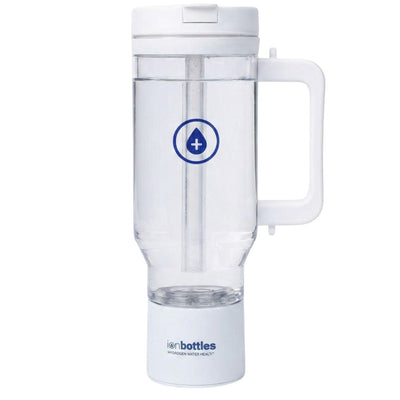
Larger formats (32 to 50 oz) deliver more total water per cycle but typically at lower concentrations. They suit all-day hydration, shared use, or situations where you want hydrogen water available over an extended period (keeping in mind that hydrogen escapes over time).
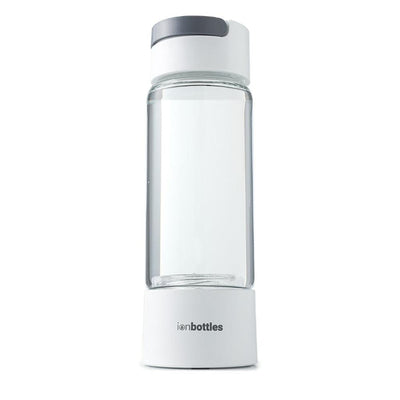
A glass hydrogen water bottle like the Pro appeals to buyers who prefer the feel and purity of glass for daily use. BPA-free Tritan options suit gym bags and commutes where glass would be impractical.
The point is not that one format is better. It is that concentration and capacity should be evaluated together, using the dose formula, not compared on PPM alone.
The Central Rule
Do not buy the biggest PPM claim. Buy the clearest proof.
A lab-tested hydrogen bottle is not “verified” in any useful consumer sense unless the exact model, cycle length, water conditions, measurement method, test date, and dissolved H₂ result are visible, and the method directly measures hydrogen rather than using ORP as a proxy.
Every brand in this space makes promises. The ones worth buying from make proof available.
If you are ready to apply this checklist to real products, compare hydrogen water bottles that publish SPE/PEM details, lab documentation, and clear warranty terms.
FAQ
What does “lab-tested” mean for a hydrogen bottle?
It should mean the exact model was tested under documented conditions for dissolved H₂ concentration, ideally by a third-party lab using gas chromatography or another direct measurement method. A badge or icon without a downloadable report is not meaningful proof.
What PPM should I look for in a hydrogen water bottle?
The IHSA uses 0.5 mg H₂ within 1 liter as a minimum dose standard source. Most informed buyers look for at least 1.0 to 1.6 PPM with independent verification. Higher claims are possible but demand proportionally stronger evidence.
Is 5.0 PPM hydrogen water realistic?
It can exist under specific conditions. At normal atmospheric pressure, roughly 1.6 mg/L is considered saturation at sea level source. Claims above that level should be supported by documentation showing the cycle length, measurement timing, and whether pressure or supersaturation contributed. The claim is not automatically false, but it needs explanation.
Is ORP the same as hydrogen concentration?
No. ORP measures overall redox potential, not dissolved hydrogen. It can be influenced by pH, minerals, and other compounds in the water source. Negative ORP alone cannot quantify how many milligrams of H₂ are dissolved.
Is H2Blue testing enough to verify a bottle?
H2Blue is a useful screening tool that can confirm whether a device produces measurable dissolved hydrogen above about 0.1 ppm source. It is helpful for ongoing home checks and for catching devices that produce little or no hydrogen. But it is technique-sensitive and approximate, and should not be treated as equivalent to a formal gas chromatography lab report.
Do CE and RoHS certifications prove hydrogen output?
No. CE is a manufacturer’s declaration that a product meets EU health, safety, and environmental requirements source. RoHS restricts hazardous substances in electronics. Both are useful compliance signals, but neither measures or verifies dissolved hydrogen concentration.
Are hydrogen water bottles FDA approved?
Be precise here. FDA’s GRAS database lists hydrogen gas for use in beverages, which supports the general safety of hydrogen as a beverage ingredient source. This is not the same as FDA approving a specific bottle or endorsing health claims. Any bottle marketed as “FDA approved” without context is overstating the regulatory record.
How long does hydrogen stay in water after generation?
Not long. Molecular hydrogen diffuses rapidly, especially once the container is opened. This is why every consumer checklist for buying lab-tested hydrogen bottles should include a question about retention data. A peak PPM number means little if hydrogen has largely dissipated by the time you drink. Best practice is to drink hydrogen water promptly after generation, ideally within minutes.