TL;DR
Hydrogen water bottles use a process called electrolysis to split water molecules into hydrogen and oxygen gas, then dissolve the hydrogen back into the water you drink. The best devices use SPE/PEM technology to separate the gases, keeping your water pure and free of byproducts like ozone. Dissolved hydrogen concentration is measured in PPM (parts per million), with research suggesting a minimum of 0.5 ppm for potential benefits. The technology traces back to NASA’s 1960s space program and is well-established, though health benefit research is still growing.
Understanding how hydrogen water bottles work is the single most useful thing you can do before spending a dollar on one. The market is full of confusing jargon, inflated claims, and cheap devices that produce little more than expensive regular water. This glossary breaks down every key term, from the chemistry inside the bottle to the numbers on the label, so you can separate real technology from marketing noise.
Considering a hydrogen water bottle? The IonBottles ATOM uses SPE/PEM electrolysis with platinum-coated titanium electrodes to deliver up to 5.0 ppm of dissolved hydrogen.
What Is a Hydrogen Water Bottle?
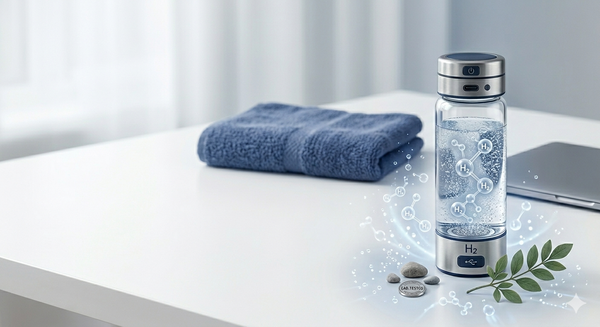
A hydrogen water bottle is a portable device that generates dissolved molecular hydrogen (H₂) in water through electrolysis, then lets you drink it immediately.
That simple definition hides important distinctions. Hydrogen water is not alkaline water, which changes pH but doesn’t necessarily add molecular hydrogen. It’s not filtered water, which removes contaminants but adds nothing. And it’s not the same as hydrogen tablets, which dissolve a pre-measured dose of magnesium-based compounds that release H₂ as a byproduct.
The electrolysis technology inside these bottles is not a wellness invention. General Electric chemists Leonard Niedrach and Thomas Grubb developed the first proton-exchange membrane electrolysis systems in the early 1960s for NASA’s Project Gemini spaceflight program. These systems served as both power sources and water management tools aboard spacecraft. What you’re holding is miniaturized industrial technology with decades of engineering behind it.
The science behind molecular hydrogen itself is substantial: over 3,000 peer-reviewed studies and 170+ human trials as of 2024, according to the Molecular Hydrogen Institute. A groundbreaking December 2025 paper published in Redox Biology identified the Rieske iron-sulfur protein, a critical component of mitochondrial Complex III, as the first clearly defined molecular target of H₂. That said, researchers consistently note that larger and longer human clinical trials are needed to confirm therapeutic claims. The technology is real. The health research is promising but still evolving.
For a deeper look at the molecular hydrogen research, see the science behind hydrogen water.
Electrolysis: The Core Process
Electrolysis is the foundation of how hydrogen water bottles work. Every device on the market, cheap or premium, relies on this process.
When you press the button on your bottle, a rechargeable battery sends an electric current through the water. That current splits H₂O molecules into their component parts: hydrogen gas (H₂) and oxygen gas (O₂). The chemical equation is straightforward:
2H₂O → 2H₂ + O₂
The device has two electrodes submerged in water. Hydrogen forms at the cathode (negative electrode), and oxygen forms at the anode (positive electrode). The hydrogen gas is then infused back into the water, making it “hydrogen-rich.”
Why Electrode Materials Matter
High-quality bottles use platinum-coated titanium electrodes. The thin platinum coating (typically 0.1 to 0.5 mg/cm²) provides excellent catalytic activity, corrosion resistance, and biocompatibility. These electrodes last 3,000 to 5,000+ electrolysis cycles with proper maintenance.
Cheaper materials corrode faster, reduce hydrogen output over time, and can leach unwanted substances into your water. If a bottle costs $25 on Amazon and doesn’t specify its electrode material, there’s a reason it’s cheap.
SPE/PEM Technology: Why It Matters
This is where the question of how do hydrogen water bottles work gets interesting, because not all bottles work the same way.
SPE stands for Solid Polymer Electrolyte. PEM stands for Proton Exchange Membrane. Together, they describe both the material and the process used to separate hydrogen from oxygen during electrolysis.
The PEM is a thin physical barrier between the two electrodes. It allows hydrogen protons to pass through while blocking oxygen and other gases. This means only hydrogen enters your drinking water. Oxygen is pushed down into a separate waste chamber and vented out through a small exhaust hole in the base of the bottle.
The membrane itself is typically made of Nafion, a sulfonated fluoropolymer developed by DuPont. It measures roughly 100 to 200 micrometers thick, thinner than a human hair, yet it is the single component that determines whether a bottle delivers pure H₂ or a cocktail of unwanted byproducts.
A quality PEM membrane operates between 5°C and 80°C and lasts 2 to 5 years with proper care.
For a thorough technical breakdown, see this guide on how SPE/PEM electrolysis works in hydrogen water bottles.
Single-Chamber vs. Dual-Chamber: A Critical Difference
In a single-chamber device, both electrodes sit in the same water. When electricity is applied, hydrogen forms at the cathode and oxygen forms at the anode, but both gases dissolve into the same water. There is no membrane separating them. The result is a mixture of dissolved hydrogen, dissolved oxygen, and any byproducts formed during electrolysis, including ozone and trace chlorine.
Practitioners on Reddit’s r/Biohackers frequently report detecting an “ozone smell” from cheap Amazon hydrogen bottles, which is a telltale sign of single-chamber electrolysis mixing byproducts into the water. The recurring pattern across these threads: sub-$40 bottles often produce what users describe as “just regular water from a fancy gadget,” with no measurable hydrogen at all.
In a dual-chamber (SPE/PEM) device, the membrane keeps the gases separated. Hydrogen goes up into your drinking water; oxygen and byproducts go down and out through the vent port.
The performance gap is significant. Typical single-chamber output is 0.3 to 0.8 ppm, while SPE/PEM devices produce 1.6 to 5+ ppm.
The Vent Port: Your Simplest Quality Check
The small exhaust hole on the bottom of a hydrogen water bottle is one of the easiest ways to confirm it uses a genuine dual-chamber design. Practitioners on Reddit’s r/Biohackers community point to the vent hole as the simplest verification method. If your bottle doesn’t have one, both gases are likely mixing into the same water you’re drinking.
Looking for a dual-chamber SPE/PEM bottle? The IonBottles Pro is a 14 oz glass option with up to 3.0 ppm output and a built-in H₂ inhaler attachment.
Henry’s Law and Why Pressure Matters Inside the Bottle
Understanding how hydrogen water bottles work requires understanding why the bottle needs to be sealed during electrolysis. The answer comes down to a gas law from 1803.
Henry’s Law states that at a constant temperature, the amount of gas that dissolves in a liquid is directly proportional to the partial pressure of that gas above the liquid. In plain language: more pressure means more dissolved gas.
Here’s the mechanical secret behind these devices. Hydrogen gas naturally resists dissolving in water. At normal atmospheric pressure, water holds almost zero hydrogen. If you simply generated hydrogen gas and left it bubbling in an open container, almost nothing would dissolve. You’d end up with regular water and a cloud of hydrogen floating away.
To fix this, the bottle seals the chamber completely. As electrolysis runs, hydrogen gas accumulates inside the sealed environment, causing internal pressure to rise. That pressure physically pushes hydrogen molecules into the water.
The Soda Bottle Analogy
Think of how a soda bottle stays carbonated while sealed, then goes flat once opened. Hydrogen water works the exact same way. The seal keeps the gas dissolved. Opening the cap starts the clock on hydrogen escaping.
Key Numbers
Under standard atmospheric conditions at room temperature, water reaches a saturation point of approximately 1.57 ppm for dissolved hydrogen. Anything above that is supersaturation, achieved under pressure inside the sealed bottle. Supersaturation is real but temporary. Once you open the cap, concentration begins dropping toward equilibrium.
One more practical detail: cold water holds more dissolved hydrogen than warm water. Gases dissolve better in cold liquids, which is why many experienced users start with chilled or room-temperature water rather than warm.
PPM, PPB, and How Concentration Is Measured
PPM stands for parts per million. In hydrogen water, it tells you the concentration of dissolved molecular hydrogen in the water you’re about to drink. The math is simple: 1 ppm equals 1 milligram of H₂ per liter of water.
PPB stands for parts per billion. The conversion: 1,000 ppb equals 1 ppm. Some brands use ppb to make their numbers look larger, which is worth knowing when you’re comparing products.
The Dose Formula Most People Miss
Concentration alone doesn’t tell the whole story. What actually matters is the total amount of hydrogen you consume, and that depends on both concentration and volume:
mg of H₂ = ppm × volume in liters
This means a 10 oz bottle at 3 ppm delivers about 0.9 mg of H₂ per cycle. A 32 oz bottle at 1.5 ppm delivers about 1.4 mg. The bigger bottle wins on total dose despite the lower concentration. This is why comparing bottles on ppm alone can be misleading, and why the IonBottles Tritan Sport Jug at 50 oz capacity makes sense for users who want maximum daily hydrogen intake.
For a complete explanation of dosing and testing, read the guide on hydrogen water PPM explained.
The Therapeutic Threshold
Most human studies have used hydrogen water in the 0.5 to 1.6 ppm range. The key number from published research: 0.5 ppm (500 ppb) is the minimum therapeutic threshold. A bottle that can’t reliably hit 0.5 ppm is, from the perspective of the existing research, producing water that falls below the concentrations studied.
ORP Is Not the Right Metric
This is a red flag worth knowing about. ORP (Oxidation-Reduction Potential) meters measure the overall redox potential of a solution, not the concentration of dissolved hydrogen. A 2022 paper in Frontiers in Food Science and Technology explicitly advises against using ORP as a proxy for dissolved H₂ concentration.
Practitioners on Reddit’s r/skeptic call this out regularly: ORP isn’t the right metric, and brands that use it as their primary proof of hydrogen content are either uninformed or deliberately obscuring the numbers. If a bottle advertises “-500 ORP” but won’t publish ppm data, be cautious.
How to Verify Your Bottle Actually Works
Knowing how hydrogen water bottles work is useful. Knowing how to verify yours is working is essential.
H2Blue Titration Drops
H2Blue is the most common brand of hydrogen titration drops. The process is simple: add drops one at a time to a water sample. Each drop that turns from blue to clear represents roughly 0.1 ppm of dissolved H₂. Count the drops until the blue color persists, and that’s your reading.
It’s not lab-grade precision, but it gives you a practical estimate that’s far more reliable than guessing.
Gas Chromatography (The Gold Standard)
For definitive ppm measurements, gas chromatography is the standard. Some manufacturers publish third-party lab test results using this method. If a brand offers lab test PDFs from accredited facilities, that’s a strong trust signal.
To learn what to look for in a lab-tested hydrogen bottle, the linked checklist walks through the key indicators step by step.
What to Watch For
Visible bubbles during electrolysis confirm gas is being produced (though they don’t confirm what gas)
A vent port on the bottom confirms dual-chamber design
Published ppm test data from a third-party lab confirms actual hydrogen output
Sealed vs. open testing matters: measuring water while the bottle is still sealed gives a higher reading than testing after it has sat in a cup for 30 seconds. Cycle stacking (running multiple cycles back to back) temporarily inflates readings too
Practical Terms Every User Should Know
Beyond the core science, understanding how hydrogen water bottles work in daily use involves a handful of practical terms.
Cycle Time
The time it takes for one electrolysis cycle to complete. This varies by device, typically ranging from 3 to 10 minutes. Longer cycles generally produce higher hydrogen concentrations. Some bottles offer multiple cycle options (for example, a 5-minute mode and a 10-minute mode) so you can choose between speed and concentration.
Supersaturation
Any dissolved hydrogen concentration above the ~1.6 ppm equilibrium point at standard pressure. It’s achievable inside a sealed bottle under pressure, but it’s temporary. Once you open the cap, the excess hydrogen begins escaping immediately.
Hydrogen Half-Life in Water
In a 500 mL open cup at room temperature with no agitation, dissolved hydrogen has a half-life of approximately two hours. Shaking, pouring, and heat all accelerate the loss. This leads to the most important practical rule.
The “Drink Immediately” Rule
Even skeptics on r/Chemistry agree on this operational point: if you’re going to drink hydrogen water, do it promptly after generation. Keeping the cap sealed and drinking within 10 to 15 minutes captures the highest concentration. Practitioners on Reddit report that back-to-back cycles before workouts, followed by immediate drinking, is the most common usage pattern among regular users.
For new users, a step-by-step walkthrough of how to use a hydrogen water bottle covers the basics.
Descaling and Maintenance
Mineral buildup on the electrolysis plates is the most common performance killer over time. This is the main factor determining how long a hydrogen water bottle lasts. Most brands recommend weekly citric acid soaks for maintenance, and you should avoid using mineral-heavy or sparkling water. Neglecting this will gradually reduce hydrogen output until the bottle barely works at all.
Quick-Reference Term Table
Term |
Definition |
Why It Matters |
|---|---|---|
Electrolysis |
Splitting water into H₂ and O₂ using electric current |
The fundamental process inside every hydrogen water bottle |
SPE (Solid Polymer Electrolyte) |
The material that enables proton-selective separation |
Ensures only pure hydrogen enters your drinking water |
PEM (Proton Exchange Membrane) |
The membrane barrier between electrodes |
Blocks oxygen and byproducts from reaching your water |
Nafion |
The fluoropolymer material most PEM membranes are made from |
Industry standard, 100-200 micrometers thick |
PPM (Parts Per Million) |
Concentration measurement; 1 ppm = 1 mg H₂/liter |
The primary metric for comparing hydrogen water devices |
PPB (Parts Per Billion) |
1,000 ppb = 1 ppm |
Some brands use ppb to inflate numbers visually |
ORP (Oxidation-Reduction Potential) |
Measures redox potential, not H₂ concentration |
Not a reliable proxy for dissolved hydrogen content |
Henry’s Law |
Gas solubility increases proportionally with pressure |
Explains why the bottle must be sealed during electrolysis |
Saturation Point |
~1.6 ppm at standard pressure and room temperature |
The natural ceiling without pressurization |
Supersaturation |
Concentration above 1.6 ppm, achieved under pressure |
Real but temporary; drops once the cap is opened |
Dual-Chamber Design |
Separate compartments for H₂ and O₂ |
Prevents ozone and chlorine from reaching drinking water |
Vent Port |
Small exhaust hole on the bottle base |
Confirms genuine dual-chamber, PEM-based design |
Platinum-Coated Titanium |
Electrode material in quality devices |
Durable, biocompatible, lasts 3,000-5,000+ cycles |
H2Blue Drops |
Titration reagent for estimating dissolved H₂ |
Each clear drop ≈ 0.1 ppm; affordable home testing method |
Cycle Time |
Duration of one electrolysis run (3-10 min typical) |
Longer cycles generally produce higher ppm |
Frequently Asked Questions
Do hydrogen water bottles actually produce hydrogen?
Quality SPE/PEM bottles with platinum-coated titanium electrodes produce measurable dissolved hydrogen, typically between 1.6 and 5+ ppm. You can verify this yourself with H2Blue titration drops. Cheap single-chamber devices, on the other hand, often produce little to no measurable hydrogen. The technology itself is proven, but not all products implement it well.
How is hydrogen water different from alkaline water?
Alkaline water has a higher pH (typically 8-9+) but doesn’t necessarily contain dissolved molecular hydrogen. Hydrogen water focuses specifically on infusing H₂ gas into the water, regardless of pH. The two are entirely different concepts. A hydrogen water bottle changes the dissolved gas content; an alkaline ionizer changes the pH.
How long does hydrogen stay dissolved in water?
In an open cup at room temperature, dissolved hydrogen has a half-life of about two hours. However, practical advice from both researchers and regular users converges on the same point: drink within 10 to 15 minutes of generation for maximum concentration. Keeping the bottle sealed until you’re ready to drink helps significantly.
What PPM should I look for in a hydrogen water bottle?
Published human studies have used concentrations in the 0.5 to 1.6 ppm range, with 0.5 ppm as the minimum therapeutic threshold identified in research. A bottle that reliably produces at least 1.0 ppm is a reasonable baseline. Remember that total dose (ppm times volume) matters more than concentration alone.
Can I use tap water or mineral water in my hydrogen water bottle?
Most manufacturers recommend using purified, distilled, or reverse osmosis water. Mineral-heavy water accelerates scaling on the electrolysis plates, reducing performance over time. Sparkling water should also be avoided, as the dissolved CO₂ can interfere with the electrolysis process.
Why do some bottles smell like ozone?
An ozone smell is a strong indicator of single-chamber electrolysis, where oxygen byproducts (including ozone) mix directly into your drinking water. Dual-chamber SPE/PEM bottles vent oxygen and ozone out through a separate exhaust port. If your bottle produces an ozone smell, it likely lacks a PEM membrane.
Is an ORP meter enough to test my hydrogen water?
No. ORP measures overall redox potential, not dissolved hydrogen concentration. Published research advises against using ORP as a proxy for H₂. If you want to know how much hydrogen is in your water, use H2Blue titration drops or look for gas chromatography lab test results from the manufacturer.
How often should I clean my hydrogen water bottle?
Most brands recommend weekly descaling with a citric acid soak. Mineral buildup on the electrolysis plates is the number one reason hydrogen output degrades over time. Consistent maintenance keeps your bottle performing near its original specs across thousands of cycles.
Now that you understand exactly how hydrogen water bottles work, the next step is finding one that delivers on the technology described here. The IonBottles ATOM offers SPE/PEM electrolysis with lab-verified output up to 5.0 ppm, backed by a 1-year warranty and a 60-day satisfaction guarantee.
Disclaimer: Hydrogen water bottles are wellness products, not medical devices. The information in this article is educational and does not constitute medical advice. While molecular hydrogen research is promising, consult a healthcare professional before making changes to your health routine.