TL;DR
SPE (Solid Polymer Electrolysis) and PEM (Proton Exchange Membrane) refer to the same core technology: a specialized membrane system that electrolyzes water to produce pure molecular hydrogen while physically blocking harmful byproducts like ozone and chlorine. Originally developed in the 1960s for NASA’s Gemini space program, SPE/PEM technology is now miniaturized into portable hydrogen water bottles. It is the key differentiator between devices that produce verified, high-concentration dissolved hydrogen and cheap devices that produce little to no measurable H₂.
The Quick Definition
SPE stands for Solid Polymer Electrolysis (sometimes Solid Polymer Electrolyte). PEM stands for Proton Exchange Membrane. In the hydrogen water industry, the terms are used interchangeably and refer to the same underlying technology: a thin, selectively permeable membrane that sits between two electrode chambers, allowing only hydrogen protons (H⁺) to pass while blocking oxygen, ozone, and chlorine gases.
The membrane itself is typically made of Nafion, a sulfonated fluoropolymer developed by DuPont, measuring roughly 100 to 200 micrometers thick. That is thinner than a human hair, yet it is the single component that determines whether a hydrogen water bottle delivers pure H₂ or a cocktail of unwanted byproducts.
One sentence summary: SPE/PEM technology is the electrolysis method that produces pure dissolved hydrogen without contaminating your drinking water.
From NASA to Your Water Bottle: A Brief History of SPE/PEM
The origin story of SPE/PEM technology has nothing to do with wellness trends. It starts with the space race.
In the early 1960s, General Electric chemists Leonard Niedrach and Thomas Grubb developed the first proton-exchange membrane electrolysis systems for NASA’s Project Gemini spaceflight program. The technology served as both a power source (fuel cells) and a water management system aboard spacecraft. Reliability was non-negotiable. The membrane had to work flawlessly in zero gravity, with zero tolerance for contamination.
Shortly after, DuPont chemist Walther Grot developed the Nafion membrane, which became the commercial standard for PEM systems. That same Nafion chemistry, refined over six decades of industrial and aerospace use, is what sits inside modern SPE/PEM hydrogen water devices.
The jump from spacecraft to water bottles happened as manufacturers realized the same electrochemical process that produced pure hydrogen for astronauts could dissolve molecular hydrogen into drinking water at therapeutic concentrations. To understand how IonBottles applies this heritage, see the detailed breakdown on our technology page.
How SPE/PEM Electrolysis Works, Step by Step
SPE PEM technology operates through a five-step electrochemical process. Each step matters, and skipping or compromising any of them is what separates a real hydrogen water device from an expensive paperweight.
Step 1: Electrical Current Hits the Electrodes
A DC current passes through platinum-coated titanium electrodes positioned on either side of the PEM. Platinum is used because it catalyzes the water-splitting reaction efficiently at low voltages. Titanium provides corrosion resistance, so no metal leaches into your water.
Step 2: Anode Reaction (The “Dirty” Side)
At the anode, water molecules oxidize:
2H₂O → O₂ + 4H⁺ + 4e⁻
This is where the byproducts form. Oxygen gas (O₂) is produced here, along with trace amounts of ozone (O₃). If the source water contains any chloride ions (common in tap water), chlorine gas (Cl₂) can also form on this side. In a properly designed SPE/PEM device, all of these gases vent out through a dedicated exhaust port, never touching the drinking water.
Step 3: Proton Transport Through the Membrane
This is the critical step. The hydrogen protons (H⁺) released at the anode migrate through the Nafion membrane via what chemists call the Grotthuss mechanism, a proton-hopping process where H⁺ ions jump between sulfonate binding sites within the membrane’s hydrophilic channels. Meanwhile, larger molecules like O₂, O₃, and Cl₂ are physically too big to pass. The membrane acts as a molecular gatekeeper.
Step 4: Cathode Reaction (The “Clean” Side)
On the cathode side, the protons that made it through recombine with electrons:
4H⁺ + 4e⁻ → 2H₂
Pure molecular hydrogen gas (H₂) forms directly in contact with the drinking water. No oxygen. No ozone. No chlorine. Just hydrogen.
Step 5: Dissolution and Collection
The freshly generated H₂ dissolves into the surrounding water. In a sealed bottle, slight positive pressure helps push hydrogen concentration beyond what open-air saturation would allow. Remaining undissolved gas can be used for inhalation through a cannula attachment on compatible devices.
For a broader look at the research supporting molecular hydrogen’s effects in the body, the science page compiles relevant clinical findings.
Why SPE/PEM Matters: The Byproduct Problem
The reason SPE/PEM technology exists in the hydrogen water context is not to produce more hydrogen. It is to keep dangerous byproducts out of your glass.
Single-chamber electrolysis devices (the kind flooding Amazon at sub-$40 price points) split water in one undivided compartment. Hydrogen, oxygen, and ozone all form in the same water you drink. If that water contains chloride ions, chlorine gas dissolves right back in. There is no membrane. There is no separation. There is no venting.
A peer-reviewed study published in PMC tested an electrolytic hydrogen-generating bottle with tap water and found that residual free chlorine actually decreased from 0.18 mg/L to 0.12 mg/L during production, and dissolved ozone remained below the detection limit of 0.05 mg/L. These numbers met safety standards in both Japan and the United States. That kind of performance requires a membrane-based separation system.
Practitioners on Reddit’s r/Biohackers frequently report detecting an “ozone smell” from cheap Amazon hydrogen bottles, which is a telltale sign of single-chamber electrolysis mixing byproducts into the water. The recurring theme across these threads: sub-$40 bottles often produce “just regular water from a fancy gadget,” with no measurable hydrogen at all.
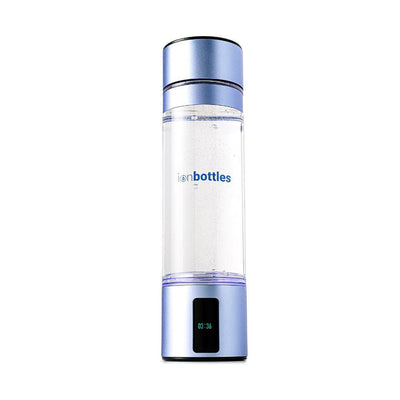
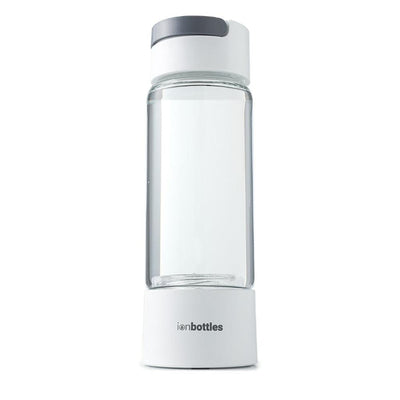
The IonBottles ATOM uses dual-chamber SPE/PEM design with a dedicated vent system to purge oxygen, ozone, and chlorine away from the drinking side. That engineering distinction is what makes high-purity, high-concentration hydrogen water possible.
SPE/PEM vs. Other Hydrogen Methods: A Direct Comparison
Not all hydrogen water devices use SPE PEM technology. Here is how the main approaches stack up.
| Feature | SPE/PEM Device | Single-Chamber (No Membrane) | Alkaline Ionizer |
|---|---|---|---|
| H₂ concentration | 1.6 to 5.0+ ppm | 0.1 to 0.5 ppm (often unverified) | 0.1 to 0.5 ppm |
| Ozone risk | Blocked by membrane, vented | Mixes into drinking water | Possible |
| Chlorine risk | Blocked by membrane | Possible from tap water chlorides | Possible |
| pH change | Neutral (6.5 to 7.5) | Slight alkaline shift | Strongly alkaline (9 to 11) |
| Typical price | $80 to $250+ | Under $40 | $1,000 to $5,000 |
A common point of confusion: hydrogen water and alkaline water are not the same thing. Alkaline ionizers raise pH dramatically but produce very little dissolved hydrogen. A 2022 PMC review confirmed that H₂ itself, not pH or ORP, is the actual active agent responsible for the antioxidant effects observed in clinical research. SPE/PEM devices keep pH neutral while maximizing what actually matters, which is dissolved hydrogen concentration.
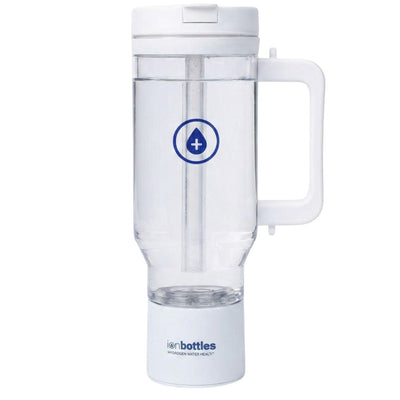
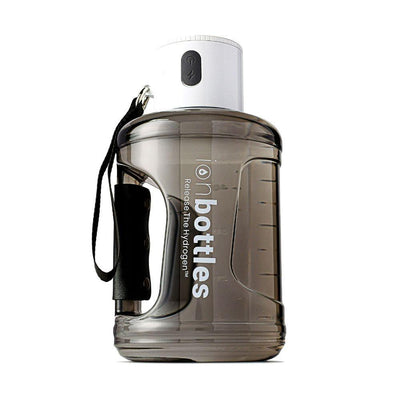
IonBottles offers SPE/PEM devices across multiple sizes, from the compact 10 oz ATOM to the 50 oz Tritan Sport Jug for all-day hydration, so the technology scales to different use cases without sacrificing purity.
Understanding Hydrogen Concentration: PPM, PPB, and Saturation Limits
Numbers mean nothing without context. Here is a quick unit conversion that clears up most of the confusion in this space:
1 ppm = 1 mg/L = 1,000 ppb ≈ 0.5 mM
According to the Molecular Hydrogen Institute, the saturation point of hydrogen in water at 1 atmosphere of pressure and 25°C is approximately 1.57 mg/L (roughly 1.6 ppm). This is the maximum concentration water can hold under normal atmospheric conditions.
So how do some bottles claim 3.0 or even 5.0 ppm? This is a question that comes up constantly on r/Chemistry and r/skeptic, and it deserves an honest answer.
Sealed bottles create slight positive pressure during electrolysis. This allows the water to temporarily hold hydrogen beyond the atmospheric saturation limit, a state called super-saturation. Values above 1.6 ppm are real and measurable, but they are temporary. Once you open the bottle, dissolved hydrogen begins escaping immediately.
The half-life of dissolved hydrogen in an open 500 mL container is approximately 2 hours. This means you should drink your hydrogen water promptly after a generation cycle, not let it sit on your desk all morning.
Clinical research on molecular hydrogen has used concentrations ranging from 0.5 to 1.6+ ppm. A 2023 PMC review identified 81 clinical trials and 64 publications on hydrogen therapy in human subjects, spanning cardiovascular, respiratory, and neurological applications. The foundational 2007 study by Ohsawa et al. in Nature Medicine first demonstrated that molecular hydrogen acts as a selective antioxidant targeting cytotoxic hydroxyl radicals. Over 2,000 scientific publications have followed.
How to Verify a Device Actually Uses SPE/PEM Technology
Marketing claims are cheap. Verification is what matters. Here is a practical checklist.
Red Flags That Suggest Fake or Missing SPE/PEM
- No visible exhaust port or vent hole. A real SPE/PEM bottle needs somewhere to expel oxygen and ozone. If the device has no vent, it has no separation.
- Price under $30 to $40. Nafion membranes and platinum-coated titanium electrodes have real material costs. Independent testers at Hydropitcher found that most budget hydrogen bottles barely produced any measurable hydrogen at all, with several producing zero.
- No third-party lab report. Look for testing from an ISO/IEC 17025 accredited laboratory, not just a marketing claim on the product page.
- Ozone smell after a cycle. If your water smells sharp or chemical after generation, byproducts are mixing into the drinking water.
- No certifications listed. CE, RoHS, and BPA-free designations are baseline safety indicators.
The H2 Blue Drop Test
The gold standard for at-home verification is H2 Blue reagent drops. Each drop neutralizes approximately 100 ppb of dissolved hydrogen. You add drops to a sample of your hydrogen water one at a time until the water stays blue. Count the drops and multiply by 100 to get your ppb reading.
This is the single most cited verification method across forums, independent review sites, and testing articles. If a bottle claims 3,000 ppb (3.0 ppm), you should need roughly 30 H2 Blue drops before the sample stays blue.
Third-Party Lab Testing
The strongest evidence comes from independent laboratory analysis. IonBottles publishes a lab test PDF for the ATOM model conducted by the Swiss Water Research Institute, an ISO/IEC 17025 accredited facility. For more details about test results and what the certifications mean, visit the FAQ page.
PEM Membrane Lifespan and Maintenance
PEM membranes do not last forever, and no honest source should tell you otherwise.
Under ideal conditions, Nafion-type membranes can last up to 10 years. In the real world of daily use in a portable hydrogen bottle, the practical lifespan depends on usage patterns. A membrane rated for 500 hours at 20 minutes per day lasts approximately 4 years, calculated with a straightforward formula:
Total rated hours ÷ Daily usage hours = Lifespan in days
For example: 500 hours ÷ 0.33 hours/day (20 minutes) = roughly 1,500 days, or just over 4 years. Source: Hydropitcher’s longevity analysis.
To maximize membrane life:
- Use filtered water. Minerals and impurities accelerate membrane degradation.
- Clean regularly. Follow the manufacturer’s recommended cleaning schedule.
- Avoid extreme temperatures. Both freezing and excessive heat damage Nafion.
- Store dry when not in use for extended periods.
IonBottles backs its devices with a 1-year warranty, and for those who want extended coverage, the Lifetime Protection plan adds peace of mind beyond the standard warranty period.
The Bottom Line on SPE/PEM Technology
SPE/PEM technology is not marketing jargon. It is a six-decade-old electrochemical engineering platform, born in the space program, validated in industrial hydrogen production, and now miniaturized into portable water bottles. The membrane is what makes the difference between drinking pure dissolved hydrogen and drinking ozone-contaminated water from a single-chamber device that may not produce any measurable H₂ at all.
The technology matters because it solves the fundamental problem of water electrolysis: keeping the good stuff (hydrogen) separate from the bad stuff (oxygen, ozone, chlorine). Without SPE/PEM, there is no reliable way to achieve therapeutic hydrogen concentrations in a portable device.
If you are evaluating hydrogen water bottles, look for verified SPE/PEM electrolysis backed by third-party lab testing, not just marketing copy. Browse the full IonBottles SPE/PEM hydrogen water bottle lineup to see the technology applied across different sizes and form factors.
Frequently Asked Questions
What does SPE/PEM stand for?
SPE stands for Solid Polymer Electrolysis (or Solid Polymer Electrolyte). PEM stands for Proton Exchange Membrane. In the hydrogen water industry, both terms refer to the same technology: a membrane-based electrolysis system that produces pure molecular hydrogen while separating out byproducts like ozone and chlorine.
Are SPE and PEM the same thing?
Functionally, yes. SPE describes the broader electrolysis category (using a solid polymer instead of a liquid electrolyte), while PEM specifically names the membrane component. In practice, every consumer hydrogen water device marketed as “SPE” or “PEM” uses the same proton-exchange membrane technology. The terms are interchangeable.
How can a hydrogen water bottle exceed the 1.6 ppm saturation limit?
Sealed bottles create slight positive pressure during electrolysis, which temporarily allows water to hold hydrogen beyond atmospheric saturation. This super-saturation is real and measurable, but it begins dissipating the moment you open the bottle. Values above 1.6 ppm should be consumed quickly, as dissolved hydrogen has a half-life of roughly 2 hours in an open container.
How do I know if my bottle truly has SPE/PEM technology?
Look for a visible exhaust vent (for byproduct separation), third-party lab reports from accredited labs, and certifications like CE and RoHS. Test at home with H2 Blue reagent drops, where each drop neutralizes about 100 ppb of dissolved hydrogen. If your bottle claims high ppm but the water stays blue after just a few drops, the device is not performing as advertised.
What happens if a hydrogen water bottle does not have a PEM membrane?
Without a membrane, the device uses single-chamber electrolysis. Hydrogen, oxygen, and ozone all form in the same water. If tap water is used, chlorine gas may also dissolve back into the drinking water. Independent testers have found that many membrane-free budget bottles produce little to no measurable dissolved hydrogen.
How long does a PEM membrane last?
It depends on usage. A membrane rated for 500 hours, used at 20 minutes per day, lasts roughly 4 years. Using filtered water and following the manufacturer’s cleaning instructions helps extend membrane life. Under ideal lab conditions, Nafion membranes can last up to 10 years.
Is hydrogen water the same as alkaline water?
No. Alkaline ionizers raise water pH to 9 to 11 but produce very little dissolved hydrogen. SPE/PEM hydrogen water bottles keep pH neutral (6.5 to 7.5) while maximizing dissolved H₂ concentration. Research indicates that molecular hydrogen, not elevated pH, is responsible for the antioxidant effects observed in clinical studies.
What concentration of hydrogen water is considered therapeutic?
Clinical studies have typically used concentrations between 0.5 and 1.6+ ppm. The Molecular Hydrogen Institute notes that atmospheric saturation is approximately 1.6 ppm, which falls within the range used in the majority of published human trials. Higher concentrations from pressurized devices may offer additional benefits, but the research base is strongest around the 0.5 to 1.6 ppm range.
These statements have not been evaluated by the Food and Drug Administration. This product is not intended to diagnose, treat, cure, or prevent any disease.