TL;DR
Choosing a hydrogen water bottle means decoding terms like SPE, PEM, PPM, ORP, and dual chamber before you can compare products meaningfully. This glossary defines every technical term you will encounter while shopping, grouped by how each one affects your buying decision. The most important things to verify are SPE/PEM electrolysis technology, lab tested PPM data, safe materials (BPA free Tritan, borosilicate glass, or food grade stainless steel), and a dual chamber design that vents harmful byproducts away from your drinking water. New sections cover PPM to PPB conversion, delivered dose calculations, water source compatibility, alkaline water vs hydrogen water, and third party certification so you can evaluate any product listing with confidence.
Contents
- How Hydrogen Water Bottles Actually Work
- Technology Terms
- Performance and Measurement Terms
- Delivered Dose: The Number That Actually Matters
- Alkaline Water vs Hydrogen Water
- Materials and Safety Terms
- Third Party and Material Safety Certifications
- Byproduct and Purity Terms
- Water Source Compatibility
- Use Case and Feature Terms
- Quick Reference Cheat Sheet
- How to Use This Glossary When Shopping
- FAQ
Shopping for a hydrogen water bottle throws you into a wall of unfamiliar abbreviations. PPM, PPB, SPE, PEM, ORP, dual chamber, Tritan, CE, RoHS. Product pages toss these terms around as if everyone knows what they mean, and most buyer’s guides repeat them without actually explaining the underlying concepts.
That gap between jargon and understanding is where bad purchases happen. Someone buys a cheap bottle because the PPM number on the listing looks high, not realizing the number was measured under sealed lab conditions that don’t reflect real world drinking. Someone else skips a quality device because they don’t know what SPE/PEM means or why it matters.
This glossary exists to close that gap. Every term is grouped by the buying decision it affects, not listed alphabetically. Each definition includes a plain language explanation and a note on why it should (or shouldn’t) influence your choice when choosing a hydrogen water bottle.
If you want to skip ahead and compare actual devices, you can browse IonBottles’ collection and cross reference specs against the criteria below.
How Hydrogen Water Bottles Actually Work
Before the glossary makes sense, you need the 60 second version of what’s happening inside these devices.
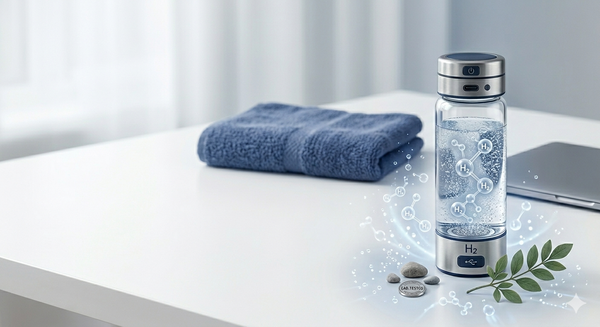
A hydrogen water bottle uses electricity to split water molecules (H₂O) into hydrogen gas (H₂) and oxygen gas (O₂). This process is called electrolysis. In a well designed bottle, a special membrane allows only hydrogen to pass into your drinking water while venting oxygen, ozone, and other byproducts out through a separate chamber.
The result is water with dissolved molecular hydrogen, measured in parts per million (PPM). You drink it, and the dissolved H₂ enters your body. That’s the entire premise.
The quality of the membrane, the electrode materials, and the bottle’s internal architecture determine whether you get clean hydrogen water or a cocktail of hydrogen mixed with ozone and chlorine byproducts. Understanding the terminology below is how you tell the difference. For a deeper technical walkthrough, IonBottles has a dedicated page on how SPE/PEM electrolysis works in their devices.
Technology Terms
These terms describe the engine of the bottle. They are the single most important category when choosing a hydrogen water bottle, because they determine whether the device actually produces clean hydrogen or just bubbles mixed with harmful gases.
SPE (Solid Polymer Electrolyte)
A type of membrane used in the electrolysis cell of a hydrogen water bottle. The SPE membrane selectively allows hydrogen protons to pass through while blocking oxygen, ozone, and chlorine from entering the drinking water.
Why it matters when choosing: SPE technology is the dividing line between bottles that produce pure hydrogen and bottles that dump all electrolysis byproducts into your water. If a product listing doesn’t mention SPE (or its close cousin PEM), that’s a red flag. Practitioners on Reddit’s r/Biohackers consistently warn against bottles that lack this membrane, noting that ozone smell and taste are the most common complaints with cheap devices. For a full breakdown of how this membrane works, see this guide on SPE/PEM technology in hydrogen bottles.
PEM (Proton Exchange Membrane)
Functionally the same technology as SPE, described from a different angle. PEM refers to the membrane’s role in exchanging protons (hydrogen ions) across its surface during electrolysis. In marketing materials, SPE and PEM are used interchangeably.
Why it matters when choosing: Don’t get confused if one brand says SPE and another says PEM. They’re describing the same membrane technology. What matters is that the bottle uses one of them. A listing that says neither should make you cautious.
Electrolysis
The core process that makes hydrogen water bottles work. An electrical current passes through water, splitting H₂O molecules into hydrogen gas and oxygen gas at separate electrodes.
Why it matters when choosing: Every hydrogen water bottle uses electrolysis. The question isn’t whether a bottle uses it, but how well the electrolysis system is designed. Cheap bottles may use basic electrolysis plates without proper gas separation, which means you’re drinking all the byproducts along with the hydrogen. A detailed explainer on this process is available in the article on how SPE/PEM electrolysis creates hydrogen.
Platinum Coated Titanium Electrodes
The electrode standard for quality hydrogen water bottles. Titanium provides structural durability and corrosion resistance. The platinum coating serves as a catalyst that increases electrolysis efficiency and prevents metal from leaching into the water.
Why it matters when choosing: Electrodes sit in direct contact with your drinking water for every cycle. Lower grade metals can corrode over time, releasing particles into the water. Platinum coated titanium is often labeled “medical grade” in marketing, and while that term is loose, the material choice itself is sound. Look for this specification on product pages.
Dual Chamber Design
An internal architecture where the electrolysis cell has two separate compartments. One chamber delivers hydrogen into the drinking water. The other collects and vents oxygen, ozone, and chlorine byproducts through an exhaust port.
Why it matters when choosing: This is arguably the most practical term on this list. Single chamber bottles let all gases mix freely in the water you drink. Dual chamber bottles keep the bad stuff out. When choosing a hydrogen water bottle, confirm the device has a dual chamber or separate vent design. If the product description doesn’t mention gas separation at all, assume it doesn’t have it.
Molecular Hydrogen (H₂)
Two hydrogen atoms bonded together, forming a gas molecule. This is the active substance dissolved in hydrogen water. It is the smallest molecule in existence, which is part of why researchers study its bioavailability.
Why it matters when choosing: Molecular hydrogen is what you’re paying for. Everything else about the bottle (membrane, electrodes, materials) exists to deliver H₂ into your water cleanly and at a useful concentration. For summaries of the clinical research behind molecular hydrogen, the Molecular Hydrogen Institute is a well regarded independent resource, and IonBottles also maintains a science and clinical studies overview.
Performance and Measurement Terms
These terms describe how much hydrogen gets into the water and how you can verify it. This is where marketing claims get slippery, so understanding the physics is worth the effort.
PPM (Parts Per Million)
The standard unit for measuring dissolved hydrogen concentration. 1 PPM equals 1 milligram of hydrogen per liter of water. This is the headline performance metric on every hydrogen water bottle listing.
Why it matters when choosing: PPM is the number everyone compares, but context matters enormously. A bottle claiming “up to 3.0 PPM” or “up to 5.0 PPM” is stating a peak measurement, typically achieved in a sealed bottle immediately after a cycle completes. Real world concentration depends on water temperature, source water mineral content, altitude, and how quickly you open the cap and drink. Always look for lab tested PPM data rather than unsupported marketing claims.
PPM to PPB Conversion
Some brands and research papers report dissolved hydrogen in parts per billion (PPB) instead of PPM. The conversion is straightforward: 1 PPM = 1,000 PPB. So a bottle claiming 1,500 PPB is producing 1.5 PPM, and one claiming 3,000 PPB is producing 3.0 PPM.
Why it matters when choosing: PPB makes numbers look dramatically larger, which is exactly why some brands use it. A listing advertising “3,000 PPB” sounds more impressive than “3.0 PPM,” but they’re identical. Always convert to PPM when comparing products side by side. If a brand uses PPB exclusively and doesn’t mention the PPM equivalent, ask yourself whether the presentation is designed to inform or to inflate. For more context on PPM numbers and what they mean in practice, the PPM explained guide breaks it down further.
Saturation Point (~1.6 PPM)
At standard atmospheric pressure and room temperature, water can hold a maximum of approximately 1.6 PPM of dissolved hydrogen. This is a physical chemistry limit, not a product specification.
Why it matters when choosing: Any bottle claiming PPM above 1.6 is achieving supersaturation through internal pressure (the sealed bottle traps hydrogen gas, forcing more into solution than would normally dissolve). This is legitimate, but the excess hydrogen escapes rapidly once you open the cap. Users on r/chemistry and r/skeptic frequently point out that many buyers don’t understand this distinction. A bottle hitting 1.2 to 1.6 PPM that you actually drink is more useful than a bottle hitting 4.0 PPM on paper if you let it sit open for five minutes.
Supersaturation
A state where dissolved hydrogen concentration exceeds the saturation point. Achieved by keeping the bottle sealed during electrolysis so that pressure builds and forces additional hydrogen into solution.
Why it matters when choosing: Supersaturation is real but unstable. The moment you open the cap, hydrogen begins escaping back into the atmosphere. This is why every knowledgeable source recommends drinking immediately after a cycle ends. Don’t dismiss high PPM bottles, but do understand that the advertised number reflects a best case scenario measured at the instant the cycle finishes.
Off Gassing (Hydrogen Retention)
The process by which dissolved hydrogen escapes from water into the surrounding air after the bottle is opened. Concentration drops measurably within minutes.
Why it matters when choosing: This is the single most practical concept for daily use. Hydrogen water is not like vitamin water, where you can sip it over an hour. Best practice is to drink within two to three minutes of completing a cycle. YouTube reviewers who test bottles with H₂ Blue reagent drops consistently show PPM declining by half or more within five to ten minutes of opening.
Therapeutic Threshold (~0.5 PPM)
Based on early clinical hydrogen research (the most cited being Ohsawa et al., 2007, published in Nature Medicine), approximately 0.5 mg/L (0.5 PPM) is often referenced as the minimum concentration studied for potential health effects in humans.
Why it matters when choosing: This number puts the PPM arms race in perspective. The difference between a bottle producing 0.2 PPM (broken or ineffective) and one producing 1.0 PPM (solid, working device) is meaningful. The difference between 3.0 PPM and 5.0 PPM has not been established as clinically significant in published research. Don’t overpay for marginal PPM increases if the base technology is the same.
ORP (Oxidation Reduction Potential)
A measurement, in millivolts (mV), of water’s tendency to gain or lose electrons. Positive ORP means the water is oxidizing. Negative ORP means it has reducing (antioxidant) capacity. Tap water typically measures +200 to +400 mV. Hydrogen rich water typically measures negative 200 to negative 600 mV.
Why it matters when choosing: ORP is a secondary indicator. It tells you the water has reducing potential, but it doesn’t directly measure how much hydrogen is dissolved. Two water samples with the same ORP can have different PPM levels. ORP meters are cheaper and more accessible than PPM testing, so some sellers use ORP as a proxy. It’s useful but not sufficient on its own.
H₂ Blue Reagent Test
A consumer grade testing method using colloidal platinum indicator drops. You add drops to a water sample one at a time. Each drop that turns clear reacts with approximately 0.1 PPM of dissolved hydrogen. When a drop holds its blue color, you’ve reached the endpoint and can count backward to estimate concentration.
Why it matters when choosing: This is the go to verification method in the biohacker and hydrogen water community. Practitioners on Reddit and YouTube consistently recommend it as the only practical way for consumers to test PPM claims at home. If you’re skeptical about a bottle’s advertised concentration, a $15 bottle of H₂ Blue drops will give you a real answer. Several users in r/Biohackers threads report testing bottles from various brands and finding real world PPM significantly lower than advertised numbers.
Gas Chromatography Verification
Gas chromatography (GC) is the laboratory gold standard for measuring dissolved hydrogen concentration. A water sample is injected into a GC instrument, which separates the dissolved gases and quantifies each one precisely. Unlike H₂ Blue drops (which give an approximation) or ORP meters (which measure a different property entirely), GC provides a direct, highly accurate PPM reading.
Why it matters when choosing: When a brand posts lab tested PPM data, look for whether the testing used gas chromatography. IonBottles, for example, publishes a lab test PDF for its ATOM bottle conducted by the Swiss Water Research Institute using GC methods under ISO/IEC 17025 accreditation. A brand that references GC verified results is showing more transparency than one that simply prints a PPM number on the box. If no testing methodology is named, the number could have come from anywhere.
Dissolved Hydrogen vs. Gas Bubbles
Dissolved hydrogen is H₂ gas that has entered solution in the water at a molecular level. Gas bubbles are visible pockets of hydrogen that haven’t dissolved. Bubbles look dramatic but escape immediately when you open the bottle or take a sip.
Why it matters when choosing: Lots of bubbles during a cycle doesn’t necessarily mean high dissolved hydrogen. A bottle that produces a fine, dense micro bubble pattern is generally more effective at dissolving hydrogen than one producing large, visible bubbles that float to the surface and pop.
Cycle Time
The duration of one electrolysis session. Most bottles offer cycles ranging from 3 to 10 minutes, with some larger capacity devices running up to 20 minutes.
Why it matters when choosing: Cycle time directly affects whether you’ll actually use the bottle daily. YouTube reviewers frequently note that 3 to 5 minutes feels manageable in a morning routine, while 10+ minutes starts to feel like a chore. Longer cycles generally produce higher PPM, so there’s a tradeoff. Some bottles offer multiple cycle options (for example, a 5 minute quick cycle and a 10 minute full cycle) to let you choose based on your schedule.
Delivered Dose: The Number That Actually Matters
Most shoppers fixate on PPM, but PPM alone doesn’t tell you how much hydrogen you’re actually consuming. The concept that ties it all together is delivered dose.
How to Calculate Delivered Dose
The formula is simple:
Dose (mg) = Concentration (mg/L) × Volume (L)
So if your bottle produces 1.5 PPM (which equals 1.5 mg/L) and holds 300 mL (0.3 L), one serving delivers 0.45 mg of molecular hydrogen. If you drink two servings, that’s 0.9 mg total daily intake.
For context, most published clinical studies have used daily H₂ doses between 0.5 mg and 1.6 mg, with some going higher. A 2020 review in the journal Molecular Medicine Reports noted that studies showing positive outcomes typically delivered at least 0.5 mg per day through hydrogen rich water.
Why This Changes How You Compare Bottles
A 10 oz bottle producing 3.0 PPM delivers approximately 0.9 mg per serving. A 50 oz jug producing 1.5 PPM delivers approximately 2.2 mg per serving. The jug has “lower PPM” on paper but delivers more than double the hydrogen per fill. This is why the PPM number on a product listing is misleading without knowing the bottle’s capacity and how much you actually drink.
Practitioners on Reddit’s biohacking communities regularly point this out: a larger capacity device at moderate PPM can be more practical than a tiny high PPM bottle that requires multiple refills. If you’re interested in higher volume options, the 50 oz Tritan Sport Jug or the 32 oz Tumbler both prioritize total delivered dose over headline PPM numbers.
Delivered Dose Quick Table
| Device Capacity | PPM | Single Serving Dose |
|---|---|---|
| 10 oz (296 mL) | 3.0 | ~0.89 mg |
| 14 oz (414 mL) | 2.5 | ~1.04 mg |
| 32 oz (946 mL) | 1.5 | ~1.42 mg |
| 50 oz (1,479 mL) | 1.5 | ~2.22 mg |
The takeaway: calculate your daily dose based on how much water you’ll realistically drink, not just the PPM on the label.
Alkaline Water vs Hydrogen Water
This is one of the most common points of confusion for new buyers. Alkaline water and hydrogen water are not the same thing, and the devices that produce them work differently.
What Alkaline Water Is
Alkaline water has a pH above 7.0, typically in the 8.0 to 9.5 range. Traditional alkaline ionizers use electrolysis to separate water into an alkaline stream and an acidic stream. The alkaline stream has a higher pH and a negative ORP. These countertop machines have been sold for decades, often at prices exceeding $1,000.
What Hydrogen Water Is
Hydrogen water is defined by dissolved molecular hydrogen content, measured in PPM. A well designed hydrogen water bottle using SPE/PEM technology adds H₂ to water without significantly changing the pH. The water stays close to neutral pH while gaining antioxidant capacity from the dissolved hydrogen.
Why the Distinction Matters
Early alkaline ionizers happened to produce some dissolved hydrogen as a byproduct of their electrolysis process, which led to confusion. Some researchers now argue that the benefits attributed to alkaline water were actually caused by the dissolved hydrogen, not the elevated pH. The Molecular Hydrogen Institute has published extensively on this point.
For buyers, the practical difference is straightforward: hydrogen water bottles are portable, affordable (often under $150), and specifically engineered to maximize dissolved H₂. Alkaline ionizers are large, expensive, and produce hydrogen only incidentally. If your goal is molecular hydrogen, a dedicated hydrogen water bottle is the more direct path.
Materials and Safety Terms
What the bottle is made of matters for health, durability, and daily usability. These terms appear on nearly every product listing, but they’re rarely explained.
BPA Free
Indicates the product contains no Bisphenol A, an industrial chemical used in certain plastics and resins. BPA can leach into liquids, particularly when heated, and has been linked to hormonal disruption in research studies.
Why it matters when choosing: BPA free is now the baseline expectation for any reputable water bottle, hydrogen or otherwise. If a hydrogen water bottle doesn’t explicitly state BPA free, consider it a disqualifying factor.
Tritan (Eastman Tritan Copolyester)
A proprietary plastic developed by Eastman Chemical Company. Tritan is BPA free, shatter resistant, lightweight, and clear. It’s widely used in sport and fitness water bottles.
Why it matters when choosing: Tritan is the standard plastic for quality hydrogen water bottles because it doesn’t react with dissolved hydrogen and withstands the heat generated during electrolysis. It’s lighter and more durable than glass, making it better for gym bags and travel.
Borosilicate Glass
A type of glass with high thermal shock resistance, commonly used in laboratory glassware and premium kitchen products (Pyrex is a well known example). It contains boron trioxide, which gives it a lower thermal expansion coefficient than regular soda lime glass.
Why it matters when choosing: Glass eliminates any concern about chemical leaching from plastics. Borosilicate glass specifically can handle temperature variations without cracking. The tradeoff is weight and fragility. Glass hydrogen bottles are better suited for home or office use than for tossing in a backpack. The Pro Hydrogen Water Bottle uses borosilicate glass for buyers who prefer this material.
Stainless Steel Components
Some hydrogen water bottles incorporate food grade stainless steel (typically 304 or 316 grade) in their outer shells, lids, or structural components. Stainless steel adds impact resistance, insulation potential, and a premium feel.
Why it matters when choosing: Stainless steel does not come into direct contact with the electrolysis process in most designs (the inner chamber is still Tritan or glass), but it affects durability and portability. If you’re rough on your gear, a bottle with stainless steel exterior elements will survive drops better than all glass construction. Just confirm that any metal parts are food grade and don’t contact the electrolysis chamber directly.
Choosing Between Materials
The best material depends on where and how you’ll use the bottle.
- Home or office, premium feel: Borosilicate glass. Zero leaching concerns, heavier, breakable.
- Gym, travel, daily carry: BPA free Tritan. Lightweight, shatter resistant, chemically inert with dissolved hydrogen.
- Rough conditions, outdoor use: Stainless steel exterior with Tritan or glass inner chamber. Best impact protection.
For a comparison of glass vs. Tritan options, the best glass SPE/PEM bottle guide goes deeper on material selection.
PFAS Free
Indicates the product is free from per and polyfluoroalkyl substances, a group of thousands of synthetic chemicals often called “forever chemicals” because they don’t break down in the environment or the human body. PFAS are used in non stick coatings, water repellent treatments, and various industrial applications.
Why it matters when choosing: PFAS contamination is an emerging consumer health concern. Not all hydrogen water bottle brands address it. If a brand specifically certifies PFAS free status, that’s a positive signal, particularly for the seals and internal components that touch your water.
Third Party and Material Safety Certifications
Certifications help separate serious manufacturers from sellers slapping a product page together. Here’s what each one actually means.
CE Marking
The letters “CE” (Conformité Européenne) on a product indicate the manufacturer declares it meets European Union health, safety, and environmental protection standards. CE marking is a legal requirement for selling electronics in the EU market.
Why it matters when choosing: CE marking is a compliance marker, not a quality award. It means the product has been assessed against relevant EU directives. Its absence from an electronic device that should have it is concerning. Its presence means the bare minimum legal requirements were met.
RoHS Compliance
Restriction of Hazardous Substances, an EU directive (2011/65/EU) that limits the use of specific toxic materials in electronics. The restricted substances include lead, mercury, cadmium, hexavalent chromium, polybrominated biphenyls (PBBs), and polybrominated diphenyl ethers (PBDEs).
Why it matters when choosing: RoHS compliance means the electronic components in the bottle’s base unit don’t contain dangerous heavy metals or flame retardants above permitted thresholds. Like CE marking, it’s a compliance floor, not a performance indicator. But a bottle without RoHS compliance is worth avoiding, since the electrolysis unit sits in direct contact with your drinking water.
ISO/IEC 17025 Lab Accreditation
This is the international standard for testing and calibration laboratories. When a lab holds ISO/IEC 17025 accreditation, its results are recognized worldwide as technically competent and reliable.
Why it matters when choosing: If a brand claims “lab tested” PPM, check whether the testing lab holds this accreditation. Results from an ISO/IEC 17025 lab carry significantly more weight than unspecified “internal testing.” This is the standard that independent verification services use.
Third Party Testing vs. Self Reported Claims
Third party testing means an independent laboratory (not the manufacturer) conducted the measurements. Self reported claims mean the brand tested its own product and published the results.
Why it matters when choosing: Third party testing is always more credible. Look for the lab name, accreditation status, and whether the full test report (or at least a summary) is publicly accessible. If a brand says “lab tested” but won’t name the lab or share results, treat the claim with skepticism. The consumer checklist for buying lab tested bottles offers a practical walkthrough of what to look for.
Byproduct and Purity Terms
Understanding what a hydrogen water bottle produces besides hydrogen is critical for choosing a hydrogen water bottle that’s actually safe. This is the category where cheap devices fail most visibly.
Ozone (O₃)
A molecule made of three oxygen atoms. Ozone is a natural byproduct of water electrolysis. In the atmosphere, ozone plays a protective role. In drinking water, it’s an irritant. High concentrations can damage lung tissue if inhaled and cause gastrointestinal discomfort if ingested.
Why it matters when choosing: Ozone is the number one red flag with cheap hydrogen water bottles. If you smell something metallic or chemical during a cycle, the bottle is likely mixing ozone into your drinking water. This means either the device lacks SPE/PEM technology or its gas separation system is poorly designed. Multiple Reddit users report this as their primary complaint with budget bottles found on Amazon.
Chlorine and Chloramine Byproducts
When electrolysis runs on chlorinated municipal tap water, the electrical current can convert dissolved chlorine into chlorine gas or form chloramine compounds. These byproducts taste and smell bad, and they’re not something you want to drink.
Why it matters when choosing: A dual chamber design with proper venting handles this problem by separating these gases from the drinking water. If you use tap water (rather than filtered or distilled), this feature is especially important. Single chamber bottles running on chlorinated tap water can produce noticeably unpleasant tasting water.
Exhaust or Vent Port
A physical opening, usually on the bottom or side of the base unit, through which oxygen, ozone, and chlorine byproducts are expelled during electrolysis. This is the visible evidence of a dual chamber design.
Why it matters when choosing: If you’re evaluating a bottle in person or in product photos, look for this port. Its presence confirms the device has a separate pathway for byproduct gases. If there’s no vent port, every gas produced during electrolysis stays in your drinking water.
Self Cleaning Mode (Descale Mode)
A maintenance cycle that runs reverse polarity electrolysis to break up mineral scale buildup on the electrodes. Hard water deposits can coat the platinum surfaces over time, reducing electrolysis efficiency and lowering PPM output.
Why it matters when choosing: Bottles with self cleaning mode maintain their PPM performance longer. Without it, electrode fouling gradually reduces hydrogen output, and there’s no easy way for the user to fix it. If you live in a hard water area, this feature matters more. For setup and maintenance tips, the guide on first use setup and activation covers best practices.
Water Source Compatibility
Not every hydrogen water bottle works equally well with every type of water. This is a topic that catches many buyers off guard.
Tap Water
Most hydrogen water bottles are designed to work with standard municipal tap water. However, tap water quality varies dramatically by region. Chlorine levels, mineral hardness, and dissolved solids all affect electrolysis performance and byproduct formation.
Practical note: If your tap water is heavily chlorinated or very hard (above 250 mg/L total dissolved solids), expect more frequent descaling cycles and potentially lower PPM output. A dual chamber design becomes even more important here because the electrolysis of chlorinated water generates chlorine gas as a byproduct.
Filtered Water
Running tap water through a basic carbon filter before filling your hydrogen bottle removes most chlorine and sediment. This reduces byproduct formation during electrolysis, improves taste, and extends electrode life by reducing mineral buildup.
Practical note: This is the sweet spot for most users. Filtered water still contains enough minerals for electrolysis to work efficiently, while removing the contaminants that cause problems.
Filter Cartridge Attachments
Some hydrogen water bottles include or offer an optional filter cartridge that sits in the fill path. These are typically activated carbon filters that remove chlorine, sediment, and some organic compounds before the water reaches the electrolysis chamber.
Why it matters when choosing: A built in filter saves you from needing a separate pitcher or faucet filter. It also reduces electrode fouling. Not all bottles offer this feature, so if your water quality is poor, it’s worth checking whether the bottle you’re considering has a filter option or at least a removable cartridge slot.
Distilled and Reverse Osmosis Water
Distilled water and reverse osmosis (RO) water have had nearly all minerals removed. This creates a problem: electrolysis requires dissolved minerals (electrolytes) to conduct electricity efficiently. Pure H₂O is actually a poor conductor.
Practical note: Using distilled or RO water in most hydrogen water bottles results in significantly lower PPM output because the electrolysis process can’t run at full efficiency. Some bottles handle this better than others depending on electrode and membrane design. If you only have access to distilled or RO water, adding a tiny pinch of mineral salt (like Himalayan pink salt) can restore conductivity, but check the manufacturer’s guidelines first. Practitioners on Reddit’s biohacking forums frequently mention this workaround.
Mineral and Spring Water
Mineral water and natural spring water generally work well in hydrogen water bottles. Their existing mineral content supports efficient electrolysis. The only concern is very high mineral content (sometimes labeled “hard” spring water), which accelerates electrode scaling.
Water Source Quick Guide
| Water Type | Electrolysis Efficiency | Byproduct Risk | Electrode Wear |
|---|---|---|---|
| Tap (low chlorine) | Good | Low to moderate | Moderate |
| Tap (high chlorine) | Good | Higher (needs dual chamber) | Higher |
| Filtered tap | Best | Low | Low |
| Distilled/RO | Poor (low conductivity) | Very low | Very low |
| Mineral/Spring | Good to excellent | Low | Moderate to high |
Use Case and Feature Terms
These terms relate to daily usability and special features that affect whether a bottle fits your lifestyle.
Portability Features
Portability matters more than most buyers realize until they’re carrying the bottle daily. Key factors include weight, size, lid security, and whether the bottle fits standard car cup holders or gym bag pockets.
What to look for: A 10 to 14 oz bottle works for commuting, desk use, and gym bags. A 32 oz tumbler with a handle suits all day carry. A 50 oz jug is best for home, office, or meal prep scenarios where you want to generate a full day’s supply at once. Slim profile bottles (under 3 inches in diameter) fit most cup holders. Wider jugs typically won’t.
Bottles with a protective sleeve or silicone grip are less likely to get damaged during transit. If you’re always on the move, Tritan construction with a secure twist cap is the most practical combination.
Hydrogen Inhalation Cannula
A nasal tubing attachment that connects to the bottle’s gas output port, allowing you to breathe in hydrogen gas directly through your nose. Some clinical research explores inhalation as a separate delivery method from drinking.
Why it matters when choosing: This is a bonus feature, not a primary buying criterion for most people. But if hydrogen inhalation interests you, buying a bottle that includes a cannula saves you from purchasing a separate inhalation device. The ATOM Hydrogen Water Bottle includes a cannula attachment for dual use hydrogen delivery.
Battery Capacity (mAh)
Milliamp hours, a unit measuring the energy storage capacity of the bottle’s rechargeable battery. Higher mAh means more electrolysis cycles per charge.
Why it matters when choosing: If you plan to use the bottle three to four times per day, look for at least 1,200 mAh. Smaller batteries mean more frequent charging, which gets annoying and can leave you without hydrogen water when you want it. Product listings should state battery capacity. If they don’t, that’s a transparency gap worth questioning.
USB C Charging
The current universal standard for charging electronic devices, including smartphones, laptops, and portable electronics. USB C cables are reversible (no wrong way to plug in) and widely available.
Why it matters when choosing: A hydrogen water bottle with USB C charging uses the same cable as most modern devices, which simplifies travel. Older bottles may use Micro USB, which signals dated electronics design and may indicate the product hasn’t been updated recently.
Warranty and Replacement Part Availability
Hydrogen water bottles are electronic devices with consumable components. They can and do fail. Warranty terms and part availability should factor into your buying decision just as much as PPM specs.
What a Good Warranty Covers
A reasonable warranty for a hydrogen water bottle covers defects in the electrolysis module, battery, and membrane for at least 12 months. IonBottles offers a 12 month warranty on their lineup, with an optional Lifetime Protection Plan available at checkout.
Why Replacement Parts Matter
The most common parts that need replacing over a bottle’s life are seals (rubber gaskets that maintain pressure during electrolysis), glass or Tritan chambers (if cracked or damaged), lids, charging cables, and cannula tubing. A brand that sells individual replacement parts signals confidence in long term product use. A brand that offers no replacement parts is essentially telling you to buy a whole new bottle when something wears out.
Before purchasing, check whether the manufacturer sells replacement seals, glass chambers, lids, and cables separately. This extends the usable life of your device and reduces long term cost.
Questions to Ask Before Buying
- Is the warranty at least 12 months?
- Does the brand sell replacement seals, lids, and glass chambers?
- Is there a clear return policy with stated timelines?
- Can you contact support directly (email, phone, chat) for troubleshooting?
Quick Reference Cheat Sheet
Use this table when you’re comparing products side by side. It maps each term to what you should look for and what should make you pause.
| Term | Good Sign | Red Flag |
|---|---|---|
| SPE/PEM | Listed and explained on the product page | Not mentioned anywhere |
| PPM | Lab tested with published results | “Up to X PPM” with no test data |
| PPM vs PPB | Concentration stated in PPM or both units | Only PPB (inflated presentation) |
| Dual Chamber | Yes, with visible vent port | Single chamber or no mention of gas separation |
| Electrodes | Platinum coated titanium specified | Electrode material not disclosed |
| Materials | Tritan, borosilicate glass, or food grade steel | Unspecified plastic type |
| Certifications | CE, RoHS, ISO 17025 lab testing | No certifications listed |
| Third Party Testing | Named lab with published methodology | “Lab tested” with no details |
| Ozone | “Ozone free” with dual chamber design | Chemical or metallic smell reported by users |
| Cycle Time | Multiple options (3, 5, or 10 min) | Only one very long cycle (15+ min) |
| Battery | Capacity stated in mAh, USB C charging | No battery specs, Micro USB |
| Water Compatibility | Works with tap and filtered; guidance provided | No mention of water type requirements |
| Warranty | 12+ months, replacement parts available | No warranty or vague terms |
| Delivered Dose | Capacity and PPM both disclosed for calculation | Only PPM stated, capacity unclear |
Print this table or keep it open in a browser tab while you shop. It condenses the entire glossary into a practical screening tool for choosing a hydrogen water bottle quickly.
How to Use This Glossary When Shopping
Now that you understand the vocabulary, here’s a framework for evaluating any hydrogen water bottle:
Step 1: Confirm SPE/PEM dual chamber technology. If the listing doesn’t mention it, move on.
Step 2: Check for posted, lab tested PPM data from a named, accredited laboratory. Marketing claims without test results are just numbers on a page.
Step 3: Verify safe materials. BPA free Tritan or borosilicate glass for the water chamber. Platinum coated titanium electrodes. CE and RoHS certifications documented.
Step 4: Calculate delivered dose. Multiply the realistic PPM (not the “up to” number) by the bottle’s capacity in liters. Compare that to the 0.5 to 1.6 mg daily range used in clinical research.
Step 5: Match capacity, cycle time, and portability features to your actual daily use. A 10 oz bottle with a 5 minute cycle suits someone who drinks at a desk. A 50 oz jug with a longer cycle suits someone prepping water for the whole day.
Step 6: Evaluate water source compatibility. If you use heavily chlorinated tap water, you need dual chamber venting and ideally a filter option. If you only have distilled water, check whether the manufacturer addresses low mineral conductivity.
Step 7: Look at the warranty, return policy, and replacement part availability. A reasonable warranty signals the manufacturer stands behind the product. Available replacement parts (seals, lids, glass) signal they expect you to use it for years.
The hydrogen water bottle market has grown fast, with devices now ranging from about $30 on marketplace sites to over $300 for premium units. The terminology can feel like a barrier, but it’s actually your best tool for cutting through marketing noise. A product that openly explains its SPE/PEM technology, posts real lab data, uses safe materials, and addresses byproduct venting is telling you something about how seriously it takes the science. A product that hides behind vague PPM claims and stock photos is telling you something too.
Compare IonBottles models side by side to see how these specs look in practice.
FAQ
What is the most important term to understand when choosing a hydrogen water bottle?
SPE/PEM (Solid Polymer Electrolyte / Proton Exchange Membrane). This membrane technology is what separates hydrogen from harmful byproducts like ozone and chlorine during electrolysis. Without it, you’re drinking everything the electrolysis process produces, not just hydrogen. It’s the single feature that distinguishes a credible device from a cheap one.
How can I test whether my hydrogen water bottle actually produces the PPM it claims?
Use H₂ Blue reagent drops, available online for about $15. Add drops one at a time to a freshly generated sample. Each drop that turns clear represents roughly 0.1 PPM. When a drop holds its blue color, you’ve found your endpoint. This is the same method used by testers on Reddit and YouTube to verify manufacturer claims, and it frequently reveals gaps between advertised and real world PPM. For the most accurate verification, gas chromatography testing in an ISO/IEC 17025 accredited lab is the gold standard.
What’s the difference between PPM and PPB?
1 PPM equals 1,000 PPB. Some brands use PPB because larger numbers look more impressive. Always convert to PPM when comparing products. A bottle listed at 2,500 PPB is producing 2.5 PPM.
Is higher PPM always better?
Not necessarily. Early clinical research references approximately 0.5 PPM as a therapeutic threshold. Any well functioning bottle producing 1.0+ PPM with clean SPE/PEM technology is delivering hydrogen at or above the concentrations studied in research. More importantly, delivered dose (PPM multiplied by volume consumed) matters more than concentration alone. A large capacity bottle at moderate PPM can deliver more total hydrogen than a small bottle at high PPM.
Why does hydrogen water need to be consumed immediately after generation?
Because of off gassing. Dissolved hydrogen escapes from water into the surrounding air within minutes of opening the bottle. Supersaturated concentrations (above 1.6 PPM) are particularly unstable and drop quickly once the seal is broken. For maximum benefit, drink within two to three minutes of completing an electrolysis cycle.
What’s the difference between a dual chamber and single chamber hydrogen water bottle?
A dual chamber bottle has two separate compartments in the electrolysis cell. Hydrogen goes into your drinking water through one chamber. Oxygen, ozone, and chlorine byproducts are vented out through the other. A single chamber bottle mixes all gases together in the water you drink. Dual chamber is the safer, more effective design.
How is hydrogen water different from alkaline water?
Alkaline water has an elevated pH (typically 8.0 to 9.5). Hydrogen water contains dissolved molecular hydrogen, measured in PPM, without necessarily changing pH. Traditional alkaline ionizers are large countertop machines that produce some hydrogen incidentally. Hydrogen water bottles are portable devices engineered specifically to maximize dissolved H₂. Researchers increasingly attribute the benefits of alkaline water to its incidental hydrogen content, not its pH.
Can I use distilled water in a hydrogen water bottle?
You can, but results will be poor. Distilled and reverse osmosis water lack the dissolved minerals needed for efficient electrolysis. The process requires ions to conduct electricity. Using distilled water typically results in significantly lower PPM output. Filtered tap water is the best option for most users: it removes chlorine and sediment while retaining enough minerals for electrolysis to work well.
Do I need a glass hydrogen water bottle, or is plastic fine?
Both are fine if the materials are high quality. Borosilicate glass offers zero chemical leaching risk and feels more premium, but it’s heavier and breakable. BPA free Tritan plastic is lightweight, shatter resistant, and chemically inert with dissolved hydrogen. Choose based on where you’ll use the bottle most. Glass for home or office. Tritan for travel and gym. Check out IonBottles’ FAQ page for more on material choices and other common questions.
Are CE and RoHS certifications meaningful for hydrogen water bottles?
They’re necessary but not sufficient. CE marking confirms the device meets EU safety requirements for electronics. RoHS compliance confirms limited use of hazardous substances like lead and mercury. Their absence is a genuine red flag. Their presence means the legal minimum was met. For stronger confidence, look for third party lab testing from an ISO/IEC 17025 accredited facility.
Should I consider warranty and replacement parts when choosing?
Absolutely. Hydrogen water bottles are electronic devices with components that wear over time. A 12 month warranty is the minimum to expect. Equally important: check whether the brand sells individual replacement parts like seals, lids, glass chambers, and charging cables. This determines whether your bottle lasts one year or five.